Showing posts with label football. Show all posts

Friday, June 11, 2010

World Cup 2010 image: France Vs Uruguay match


World Cup match 2 : live blog -Uruguay Vs France


Uruguay's players, on the other hand, are scattered across the globe playing for teams as varied as Newcastle United to FC Porto. If Suarez and Forlan can find space early, expect Uruguay to also find the back of the net (Rule number one of the WC live blogs: the goal will not be referred to as an onion bag.)

1 Fernando Muslera
2 Diego Lugano
3 Diego Godin
6 Mauricio Victorino
17 Egidio Arevalo
15 Diego Perez
18 Ignacio Gonzalez
11 Alvaro Pereira
16 Maxi Pereira
9 Luis Suarez
10 Diego Forlan

If you're a fan of Arsenal or Chelsea you'll recognize about half of your respective team. France fields a pretty standard team. Everyone expected Henry to start from the bench and that's just where he'll be.

1 Hugo Lloris
3 Eric Abidal
5 William Gallas
13 Patrice Evra
2 Bacary Sagna
19 Abou Diaby
14 Jeremy Toulalan
21 Nicholas Anelka
8 Yoann Gourcuff
7 Franck Ribery
10 Sidney Govou

Now Referee, Players of both team are going to the field.

Uruguay is singing own national song.

Now France singing.

Referee :Yuichi Nishimura (Japan).

The game is start.

at 07 minute:
it's a great miss for france. Reveri made a very nice cross. but just touch...

at 16 minute:
Forlan's shot. it's so speedy and nice shot but France goalkeeper just punch.

19 min:
Franck Ribery gets booked for hanging out of the shirt of ... somebody. Despite being from Japan, the referee manages to do everything in the right order, blowing his whistle, removing the card from his pocket, writing the correct player's number on the back of it and then holding it up in the air. Well done, Yuici Nishimura! Well done, you. Mark Lawrenson, Steve Wilson and the rest of the BBC team will be very impressed, what this being such a big game and you being a funny foreigner.

25 min:
Still scoreless - it's a decent enough match and there have been two or three good chances, but it's considerably more pedestrian than the opener between South Africa and Mexico.

27 min:
Abou Diaby slaloms down the right flank and crosses the ball into the Uruguay penalty area. There's one ... two .. three ... four ... five Urugay players in there waiting to clear and not a Frenchman in sight.

29 min:
Yes, his fault. Paolo Bandini of Serie A expertise fame. It seems he's too big-time to bother with trifles like setting up very important minute-by-minute reports for his elders and betters.

30 min:
In for Florent Malouda, much to the considerable indignation of the French nation, Abou Diaby is having a great game. He almost puts Sidney Go9uvou clean through on goal with a curling pass from deep that's intercepted by Nicolas Anelka in an offside position. The linesman flags, managing to successfully wave the garish cloth bit at the end of the stick in his hand, despite being from Japan. If Anelka had left that ball alone, Govou would have been clean through on goal and onside.

34 min:
Forlan drops deep, picks up the ball, turns and charges towards the edge of the France penalty area. Suarez darts out to the right channel and his strike partner pings the ball his way. Offside! That's very careless on the part of Suarez - there was no reason for him to get caught offside there.

35 min:
"He's been good, y'know, the referee," says BBC match analyst Mark Lawrenson, managing to sound amazed. England's match official Howard Webb is probably listening to this commentary, beseeching assorted BBC broadcasters to stop ratcheting up the pressure on him by repeatedly patronising refs who are "not used to big games". It'll just make him look even more of an idiot, come the inevitable gaffe.

39 min:
"I watched the game this afternoon and it's the last SA game I will watch," writes Anthony O'Connell in Dublin, before adding his voice to the incessant, irritating drone of people complaining about vuvuzelas. "The noise of those poxy horns it's like wavin pipe. Also the lads on Off The Ball likened them to air horns, but at least they run out of air. Also reminds me of that fat bloke ringing the bell at Pompey! Jesus, me head was wrecked. Seriously RTE got a lot of calls from people thinking there was something wrong with the sound." People in South Africa celebrating the World Cup in a traditional South African manner. How dare they?

Half time Uruguay 0 - France 0

Now start 2nd half.

47 min:
Uruguay win a throw-in deep inside their own half. Alvaro Perreira takes it and assorted team-mates of his ping the ball around midfield. Ignacio Gonzalez moves it forward, trying to pick out Diego Forlan, but William Gallas clears.

50 min:
A free-kick for Uruguay, over by the touchline, about 45 yards from the France goal. It's swung in towards the far post, where Abou Diaby performs heroics to leap highest and head the ball out towards the far touchline, when Godin was lurking behind him. Moments later, the ball is sent into the mixer again, this time Gallas clears, but gets accidentally hoofed in the knackers by Diego Forlan for his troubles. He'll live.

55 min:
From 40+ yards out from goal, Jeremy Toulalan tries his luck. The Jabulani fizzes in the air before bouncing in front of Uruguay goalkeeper Fernando Muslera, who gets down to his right to save comfortably.

59 min:
Uruguayan defender Mauricio Victorino gets booked for a late tackle on Patrice Evra. Free-kick for France in the left channel, in line with the edge of the 18 yard box.

62 min:
Bacary Sagna fouls Luis Suaraz, conceding a free-kick to Uruguay, five yards outside the France penalty area, in line with the left-hand side of it. Forlan sends a fizzing shot over the wall, it bounces in front of Hugo Lloris and the goalkeeper claims.

64 min:
Just before that free-kick, Uruguay made a susbtitution: Ignacio Gonzalez off, Ajax's Nicolas Lodeiro on. Just after that, Patrice Evra was very lucky not to get sent off, going in with a late tackle that could easily have earned him a second yellow.


66 min: The referee blows for a France free-kick when goalkeeper Hugo Lloris and Luis Suarez contested a high ball on the edge of the six-yard box. Lloris dropped the ball, but Suarez was ajudged to have fouled him, as is customary when a striker jumps in the same postal distract as an opposition goalkeeper.


68 min:
Jeremy Toulalan gets booked for a late, clumsy lunge on Alvaro Perreira, prompting Uruguay captain Diego Lugano to go forehead to forehead with the French midfielder. Raymond Domenech saunters on to the pitch to try to sort it out and is promptly ushered off by the fourth official.

70 min:
Suarez picks up the ball on the right wing, cuts inside and tries to nutmeg Eric Abidal with a view to running around him to collect the ball and pick out Diego Forlan in space. Abidal blocks the ball.

71 min:
With the match drifting away from his side, Raymond Domenench makes a long overdue substitution. It's a straight swap: Thierry Henry for Nicolas Anelka. I'm surprised he hasn't hauled off Sidney Govou, who's done nothing in this second half.

75 min:
Amid all the administrative housework involved on my part with those substitutions, Diego Forlan had a good chance to put Uruguay one up. From a long throw, Luis Suarez headed the ball into his path and unmarked from 15 yards, he rifled a low drive a couple of feet wide of Hugo Lloris's right upright.

77 min:
"Crazy shot time! Let's go!" Tweets MFUSA in the Twitter feed that's somehow found it's way on to the right-hand side of this minute-by-minute report.

79 min:
Malouda tries a shot from distance. It's a good effort, flashing across the face of goal and ultimately wide, but giving Fernando Muslera plenty to think about along the way.

RED CARD! The first red card of the tournament goes to the Uruguay substitute Nicolas Lodeiro, who picks up his second yellow card for a ridiculously late and quite dangerous tackle on Bacary Sagna. His first was for was kicking the ball away and he walks off 20 minutes after taking to the field without a word of complaint. Truth be told, he could have had a red card for that tackle alon - on the stretch and with studs up, he caught Sagna right on his instep.

83 min:
On the left flank, Franck Ribery cuts inside Arvelo Rios and tries to get a cross into the penalty area. It's blocked. The ball goes out for a throw-in and France make their third substitution: Andre Pierre Gignac on, Sidney Govou off.

85 min:
"A Uruguayan red card?" writes Gary Naylor. "I'm all nostalgic." Yup, takes me back too, although it wasn't a really dirty foul, in the grand old tradition of this great South American nation.

87 min:
Uruguay substitituion: Maxi Pereira off, Eguran on.

88 min:
From the right wing, France cross the ball into the Urtuguay penalty area. The ball bounces up and hits Eguran on the hand - Thierry Henry, of all people, appeals for a penalty. Oh, the irony. The referee, quite correctly, doesn't give one.

90+1 min:
Gignac, who is a centre-forward by trade, has been stationed out on the right wing, where Florent Malouda should be but isn't - he's playing centre-forward. Gignac tries to get a cross in, but his effort is blocked.

90+3:
Free kick from Henry but no destination.

Full time: Uruguay 0 - France 0
This game is closed. Each team got one point. Good bye for today.

Thursday, June 10, 2010

World Cup weekend of wondrous football

The 19th World Cup and first in Africa kicks off in a few hours and we can't wait. First up is South Africa versus Mexico and while our match report will touch on this later, we feel sorry for Mexico in a way - it isn't going to be easy.

After that, we have France against Uruguay in Cape Town and if the performance from William Gallas earlier this week wasn't strange enough, if France lose tomorrow, you'll hear from his coach and master, Raymond Domenech, who is the real master at sounding strange.

After the first day - we then get to the serious business of England versus the USA and it will be a cracker, but before that we have Argentina up against Nigeria and Korea Republic against Greece from Group B. Five games in and we are still on Saturday! I think the penny has just dropped as to why we only have this every four years; I think my wife would leave me.

On Sunday we have Algeria versus Slovenia to complete the first round of matches for Group C and then the start of Group D with Germany playing Australia and Serbia playing Ghana.

What more could you ask for? Football all weekend starting late Friday afternoon - is it Christmas already? Remember to follow our updates on Twitter and come back later for our match previews and don't forget we have all the fixtures and results updated as they happen.

The World Cup is finally here. Let's go have some fun!

source:www.worldcup2010southafrica.com

Sunday, May 23, 2010

This is my last world Cup: Steven Gerrard said


London: England footballer Steven Gerrard has said that that he will take stock on his international career after next month’s World Cup in South Africa.

“My thinking is to make the most of this World Cup because it could be my last. I turn 30 in a week and you never know what will happen down the line,” News of The World quoted Gerrard, as saying.

“I’ve never considered finishing for England, but a lot of the players are coming to an age where they will have three or four weeks' holiday after the World Cup to consider their next move,” he added.

The midfielder also believes that a lot depends on how well his team does in the tournament and what the manager might be thinking.

“When you get to 30, it's an age where I would consider, internationally, what I am going to do moving forward and also what I have achieved. I don't want to step out of this level of football if we haven't achieved something,”

“If we do really well, it might influence my thinking, but I haven't given it much thought. I'm guessing this could be my last World Cup. With the standard of players behind me, I wonder whether I would be good enough to hold down a place in the 23,” he added.

Saturday, May 22, 2010

World Cup 2010 South Africa Stadium : The Nelson Mandela Bay Stadium

Stadium No. 9: The Nelson Mandela Bay Stadium
Situated: Port Elizabeth


Map & Directions

Click here to view a map of the stadium and the local area.
The Stadium

The Nelson Mandela Bay Stadium will have a capacity of 49,500 and will be a multi purpose facility launched at the World Cup in 2010.


Group matches to be played in Port Elizabeth:

* 12th June - 1.30pm: Korea Republic v Greece
* 15th June - 4.00pm: Ivory Coast v Portugal
* 18th June - 1.30pm: Germany v Serbia
* 21st June - 4.00pm: Chile v Switzerland
* 23rd June - 4.00pm: Slovenia v England

World Cup 2010 South Africa Stadium : The Peter Mokaba Stadium

Stadium No. 8: The Peter Mokaba Stadium
Situated: Polokwane


Map & Directions

Click here to view a map of the stadium and the local area.
The Stadium

The roof over the existing west stand of the Peter Mokaba Stadium will be removed and replaced by a roof that covers the entire western stand of the new Stadium.

An additional 20 rows of seating will be built around the entire stadium to increase capacity to 40,000.

In addition to the structural work, the Peter Mokaba stadium will be provided with first rate equipment, including an electronic scoreboard in the northern stand, new floodlights, a modern sound system and a fire detection and protection system.

Group matches to be played in Polokwane:

* 13th June - 1.30pm: Algeria v Slovenia
* 17th June - 8.30pm: France v Mexico
* 22nd June - 8.30pm: Greece v Argentina
* 24th June - 4.00pm: Paraguay v New Zealand

World Cup 2010 South Africa Stadium : The Royal Bafokeng Sports Palace

Stadium No. 6: The Royal Bafokeng Sports Palace
Situated: Rustenburg


Map & Directions

Click here to view a map of the stadium and the local area.
The Stadium

Only minor renovations will be required to bring the Royal Bafokeng Sports Palace into line with requirements for a stadium able to host first and second round matches at the 2010 World Cup. The stadium will have a capacity of just over 40,000.

For 2010, essentially cosmetic measures such as installation of new electronic scoreboards and upgrading of the floodlights and public address system will render the Royal Bafokeng Sports Palace ready to welcome the football supporters of the world.

Group matches to be played in Rustenburg:

* 12th June - 8.30pm: England v USA
* 15th June - 1:30pm: New Zealand v Slovakia
* 19th June - 4.00pm: Ghana v Australia
* 22th June - 4.00pm: Mexico v Uruguay
* 24th June - 8.30pm: Denmark v Japan

Friday, May 21, 2010

Fifa admit World Cup sales in Africa 'poor'


Mr Valcke previously said the event was a "real African World Cup"

A senior Fifa official has said he was "disappointed" by the number of World Cup tickets sold to fans in African countries.

Jerome Valcke said only 40,000 tickets have been sold in countries in the continent outside of South Africa.

The football body has faced criticism for not making tickets accessible to Africans, as most tickets were being sold via the internet.

It is the first time the World Cup is being held on African soil.
'Priced out'

Mr Valcke - who has previously billed the event as a "real African World Cup" - said that African sales were "poor" and that Fifa would have to re-think its strategy towards Brazil, hosts of the 2014 Cup.

"It's really not a lot of tickets when you think that we have so many African countries playing in the World Cup," he said at a press event in South Africa.

"The system that we put in place was not perfect for South Africa and for Africa".

He said that there were also difficulties in air travel from one African country to South Africa.

South African Tourism Minister Martinus van Schalkwyk said on Tuesday that the figures were 76% less than those forecasted for the event.

He said that only 11,300 people in Africa made ticket purchases, out of a total of 230,000 foreign fans.

In March, Mr Valcke denied that Africans were being priced out of tournaments.

While tickets in South Africa were offered at a lower price, fans in other African countries had to pay the standard amount - with the cheapest costing $80 (£54).

Critics also said that many Africans would face difficulties accessing the internet, or might not have a credit card to make purchases online.

Over 2.5 million tickets have been sold out of 3 million available for the World Cup, which begins in three weeks.

More than a million have been bought by South Africans.

North Korea 'will not' travel to Zimbabwe pre-World Cup


North Korea will not be preparing for the World Cup finals with a visit to Zimbabwe, ending fears over a potentially controversial trip.

The Zimbabwe government had suggested the Asian side would stop in the country on their way to South Africa.

That sparked protests in Matabeleland, where rights groups say a North Korean-trained army unit killed thousands of people during the 1980s.

But the government now say they have heard nothing from the North Koreans.

"I will check on the progress of the North Korea team but I don't think that they will stop in Zimbabwe," Tourism Minister Walter Mzembi said.

Sports Minister David Coltart added he no longer expected the North Korea team to come.

The country's football association, Zifa, said it had never invited the team to come and train.

North Korea are expected to play Greece, DR Congo and Nigeria in the build-up to the World Cup - they are in Group G along with Brazil, Ivory Coast and Portugal.

Gary Neville has questioned England manager Fabio Capello's decision to pick Liverpool's Glen Johnson as his sole right-back for the World Cup


Johnson has established himself as England's first-choice right-back under Capello, but suffered an injury-interrupted second half of the season.

And Neville said: "I'm surprised there is only one right-back in the squad."

Neville also labelled attempts to lure Paul Scholes out of international retirement "a bit desperate".

Despite failing in his attempt to bring Scholes back into the England fold, Capello did persuade Liverpool's Jamie Carragher to return to the squad three years after his own international retirement.

And although Carragher has played the majority of his career at centre-back, his ability to cover either full-back position was seemingly key in Capello's decision to overlook Manchester United's Neville and Wes Brown.

However, Neville argued that Brown, who started at right-back when England beat Egypt in their last fixture as Johnson recovered from knee ligament damage, was unlucky to miss out.

"I wouldn't say I'm overly disappointed not to be named in the initial 30-man squad, although I did think there was maybe a chance I could get in," added Neville, who made 15 Premier League starts last season but failed to add to his 85 England caps.

"I'm probably more surprised Wes Brown isn't in the 30, to be honest."

Scholes, who retired from international football in 2004, appeared set for a return of his own before eventually rejecting Capello's overtures.

And Neville admitted that courting Scholes made sense, even if it was unlikely to succeed.

"I'm not surprised Capello tried to get him out of retirement because if there's one player I would try to pull out of retirement it's Scholes," Neville said of his team-mate and fellow 35-year-old.

"Capello maybe got a bit desperate at the last minute and wanted Scholes because he's still probably the best midfielder in England, but Scholes decided to stick to his guns."

Meanwhile, Manchester City have confirmed that midfielder Gareth Barry has been sleeping in an oxygen tent in an attempt to speed up his recovery from an ankle injury.

Capello remains hopeful that Barry will be fit for England's second World Cup group game against Algeria on 18 June.

Before that the Italian is set to assess defenders Ledley King and Jamie Carragher in the sold-out friendly against Mexico at Wembley on 24 May.

Neither have played for England since the end of Steve McClaren's reign in 2007.

England footballers model new World Cup suits


The England team have shown off their official World Cup suits - and there is more than just a hint of 1966 in the design.

Forty-four years ago, Sir Alf Ramsey's World Cup winners sported an ensemble with thin lapels and narrow trousers - a look England manager Fabio Capello was keen to see repeated.

He asked for the thin lapels, a slim silhouette, and slanted pockets - and if Marks & Spencer could provide an injury free defender at right back too, that would be a bonus.

Created in collaboration with Savile Row tailor Timothy Everest, the suit marks a break away from the designer attire of previous years, and the more superstitious might hope that it will even inspire a change in the team's World Cup fortunes.

M&S' menswear director Richard Price said: "The Football Association and M&S are both great British institutions so we are extremely proud to continue to dress the England team as they travel to South Africa this summer."

The suit will be available for fans to buy in stores and online.

Thursday, May 20, 2010

Biography of Jules Rimet Trophy


The Jules Rimet Trophy was the original prize for winning the World Cup. Originally I was called "Victory", but generally now known simply as the World Cup or Coupe du Monde, I was officially renamed in 1946 to honour the FIFA President Jules Rimet who in 1929 passed a vote to initiate the competition. Designed by Abel Lafleur and made of gold plated sterling silver on a blue base of lapis lazuli, i stood 35 cm high and weighed 3.8 kg. I was designed in the shape of an octagonal cup, supported by a winged figure representing Nike, the ancient Greek goddess of victory.

During World War II, I was held by Italy. Ottorino Barassi, the Italian vice-president of FIFA, and hidden from the Germans in a shoe-box under his bed.

Just before the 1966 World Cup Final in England I was stolen during a public exhibition at Westminster Central Hall, but was found just seven days later, wrapped in newspaper at the bottom of a suburban garden hedge in Norwood, South London, by a dog named "Pickles". As a security measure, The FA secretly manufactured a replica of me for use in the post-match celebrations. The replica was also used on subsequent occasions until 1970. The replica was sold at an auction in 1997 for £254,500, when it was purchased by FIFA who subsequently arranged for it to be displayed at the English National Football Museum in Preston.

The Brazilian team won me for the third time in 1970, and were rewarded by being allowed to keep me in perpetuity. However, I was stolen again in 1983 in Rio de Janeiro and never recovered; some think I may have been melted down. The Brazilian Football Confederation commissioned a replica of their own.


Jules Rimet Trophy

Brazil - 1958, 1962, 1970
Uruguay - 1930, 1950
Italy - 1934, 1938
West Germany - 1954
England - 1966


And since :

West Germany - 1974, 1990
Argentina - 1978, 1986
Italy - 1982, 2006
Brazil - 1994, 2002
France - 1998

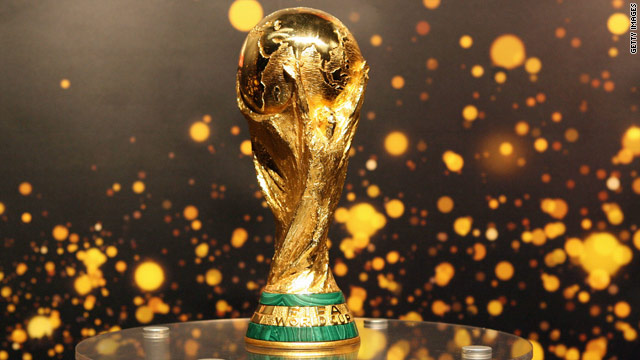
FIFA World Cup Trophy


With the Jules Rimet Cup being awarded permanently to Brazil after their third FIFA World Cup triumph in Mexico City in 1970, FIFA commissioned a new trophy for the tenth FIFA World Cup in 1974. Experts from seven countries submitted a total of 53 designs to FIFA, with the final choice being the work of Italian artist Silvio Gazzaniga.


The FIFA World Cup Trophy is made of solid gold and malachite. It is made by the Italian sculptor Silvio
Gazzaniga. He described his creation in these words: "The lines spring out from the base, rising in spirals, stretching out to receive the world. From the remarkable dynamic tensions of the compact body of the sculpture rise the figures of two athletes at the stirring moment of victory". The trophy is 36 cm high, made of solid 18-carat gold and weighs 4,970 grams. The base contains two layers of semi-precious malachite and has room for 17 small plaques bearing the name of the winners - space enough for the World Champions up to the year 2038. The current FIFA World Cup Trophy cannot be won outright, as the regulations state that it shall remain FIFA's own possession. The World Cup winners retain it until the next tournament and are awarded a gold-plated replica.

The winning teams, whose legendary players have carried the Trophy in triumph at FIFA World Cup finals are: Germany (1974), captained by Franz Beckenbauer; Argentina (1978), captained by Daniel Pasarella; Italy (1982), captained by Dino Zoff; Argentina (1986), captained by Diego Maradona; Germany (1990), captained by Lothar Matthaus; Brazil (1994), captained by Dunga; France (1998), captained by Didier Deschamps and Brazil (2002), captained by Cafu.

FIFA World Cup 2010 full fixtures,dates and times


Friday, 11 June
2010 FIFA World Cup
South Africa v Mexico, Gp A, 15:00
Uruguay v France, Gp A, 19:30

Saturday, 12 June
2010 FIFA World Cup
Argentina v Nigeria, Gp B, 12:30
England v USA, Gp C, 19:30
South Korea v Greece, Gp B, 15:00

Sunday, 13 June
2010 FIFA World Cup
Algeria v Slovenia, Gp C, 12:30
Germany v Australia, Gp D, 15:00
Serbia v Ghana, Gp D, 19:30

Monday, 14 June
2010 FIFA World Cup
Italy v Paraguay, Gp F, 19:30
Japan v Cameroon, Gp E, 15:00
Netherlands v Denmark, Gp E, 12:30

Tuesday, 15 June
2010 FIFA World Cup
Brazil v Korea DPR, Gp G, 19:30
Ivory Coast v Portugal, Gp G, 15:00
New Zealand v Slovakia, Gp F, 12:30

Wednesday, 16 June
2010 FIFA World Cup
Honduras v Chile, Gp H, 12:30
South Africa v Uruguay, Gp A, 19:30
Spain v Switzerland, Gp H, 15:00

Thursday, 17 June
2010 FIFA World Cup
Argentina v South Korea, Gp B, 19:30
France v Mexico, Gp A, 12:30
Greece v Nigeria, Gp B, 15:00

Friday, 18 June
2010 FIFA World Cup
England v Algeria, Gp C, 19:30
Germany v Serbia, Gp D, 12:30
Slovenia v USA, Gp C, 15:00

Saturday, 19 June
2010 FIFA World Cup
Cameroon v Denmark, Gp E, 19:30
Ghana v Australia, Gp D, 12:30
Netherlands v Japan, Gp E, 15:00

Sunday, 20 June
2010 FIFA World Cup
Brazil v Ivory Coast, Gp G, 19:30
Italy v New Zealand, Gp F, 15:00
Paraguay v Slovakia, Gp F, 12:30

Monday, 21 June
2010 FIFA World Cup
Chile v Switzerland, Gp H, 15:00
Portugal v Korea DPR, Gp G, 12:30
Spain v Honduras, Gp H, 19:30

Tuesday, 22 June
2010 FIFA World Cup
France v South Africa, Gp A, 15:00
Greece v Argentina, Gp B, 19:30
Mexico v Uruguay, Gp A, 15:00
Nigeria v South Korea, Gp B, 19:30

Wednesday, 23 June
2010 FIFA World Cup
Australia v Serbia, Gp D, 19:30
Ghana v Germany, Gp D, 19:30
Slovenia v England, Gp C, 15:00
USA v Algeria, Gp C, 15:00

Thursday, 24 June
2010 FIFA World Cup
Cameroon v Netherlands, Gp E, 19:30
Denmark v Japan, Gp E, 19:30
Paraguay v New Zealand, Gp F, 15:00
Slovakia v Italy, Gp F, 15:00

Friday, 25 June
2010 FIFA World Cup
Chile v Spain, Gp H, 19:30
Korea DPR v Ivory Coast, Gp G, 15:00
Portugal v Brazil, Gp G, 15:00
Switzerland v Honduras, Gp H, 19:30

Saturday, 26 June
2010 FIFA World Cup
Winner Gp A v Runner-up Gp B, 16R, 15:00
Winner Gp C v Runner-up Gp D, 16R, 19:30

Sunday, 27 June
2010 FIFA World Cup
Winner Gp B v Runner-up Gp A, 16R, 19:30
Winner Gp D v Runner-up Gp C, 16R, 15:00

Monday, 28 June
2010 FIFA World Cup
Winner Gp E v Runner-up Gp F, 16R, 15:00
Winner Gp G v Winner Gp H, 16R, 19:30

Tuesday, 29 June
2010 FIFA World Cup
Winner Gp F v Runner-up Gp E, 16R, 15:00
Winner Gp H v Runner-up Gp G, 16R, 19:30

Friday, 2 July
2010 FIFA World Cup
Wnr Gp A/R-Up Gp B v Wnr Gp C/R-Up Gp D, QF, 19:30
Wnr Gp E/R-Up Gp F v Wnr Gp G/R-Up Gp H, QF, 15:00

Saturday, 3 July
2010 FIFA World Cup
Wnr Gp A/R-Up Gp B v Wnr Gp D/R-Up Gp C, QF, 15:00
Wnr Gp F/R-Up Gp E v Wnr Gp H/R-Up Gp G, QF, 19:30

Tuesday, 6 July
2010 FIFA World Cup
Winner Q/F 1 v Winner Q/F 3, SF, 19:30

Wednesday, 7 July
2010 FIFA World Cup
Winner Q/F 2 v Winner Q/F 4, SF, 19:30

Saturday, 10 July
2010 FIFA World Cup
Loser SF1 v Loser SF2, F, 19:30


Sunday, 11 July
2010 FIFA World Cup
Winners SF1 v Winners SF2, F, 19:30

Maps of World Cup 2010 Venues


Disclaimer : All efforts have been made to make this image accurate. However Compare Infobase Limited,its directors and employees do not own any responsibility for the correctness or authenticity of the same.

The 19th FIFA World Cup is going to commence from 11th of June and final match will be played on 11th of July.First time any African country i.e. South Africa will host the FIFA World Cup 2010 in the cities Bloemfontein, Cape Town, Durban, Johannesburg, Kimberley, Polokwane, Port Elizabeth, Pretoria, Orkney, Rustenburg, and Nelspruit.

However, qualification process had been commenced in August 2007 and completed in November 2009. The total country qualified for the FIFA World Cup 2010 is 32.

History of World Cup 2006


Winners: Italy
Teams: 32
Teams in qualifiers: 198
Notable Absentees Cameroon, Nigeria
Surprises Angola, Ivory Coast, Ghana, Togo, Trinidad & Tobago
Golden Boot: Miroslav Klose (Germany) - 5
Stats A total of 147 goals were scored (2.30 per match); Germany (14) scored the most
Format Eight groups of four, with the top two teams in each group advancing to a knockout round of 16
Number of matches 64

Innovations
• For the first time, the holders (Brazil) did not gain automatic entry to the tournament
• Fan zones, showing matches on giant screens in open urban areas, were introduced and subsidised by sponsors. An estimated 750,000 fans packed the zone at the Brandenburg Gate for Germany's second-round match against Sweden

Controversies
• FIFA ordered a replay after Uzbekistan beat Bahrain 1-0 in the first leg of an Asia play-off, citing a "refereeing error" - the goal had come from a illegally-taken penalty. Bahrain eventually won the two-legged contest
• In the group match between Croatia and Australia, English referee Graham Poll mistakenly issued three yellow cards to Croatian Josip Simunic before sending him off
• FIFA forced spectators to remove Leeuwenhosen - orange-colored, lion-tailed overalls distributed by a Dutch brewery - ahead of a Netherlands match because the brewery concerned was not an official tournament sponsor. As a result, some fans watched the game in their underwear

Trivia
• The final attracted an estimated audience of 715.1 million people
• There were a record-breaking 326 yellow cards and 28 red cards issued, with Russian referee Valentin Ivanov handing out 16 yellows and four reds in the game between Portugal and Netherlands
• To banish evil spirits, a priest from Ecuador visited all the World Cup stadia ahead of the tournament
• Switzerland became the first team to be knocked out after not conceding a goal in the first two rounds - they lost on penalties to Ukraine in the second round

Germany's bid to win their chance to welcome the world to their own Weltmeisterschaft was fraught with pragmatic intrigue. Before a remarkable U-turn from FIFA delegates that is still wrapped in bribery allegations saw Nelson Mandela and co forced to wait another four years, South Africa was fully expected to be the destination of the 2006 finals.

Controversy set aside, until the football began at least, the Germans set their much-mooted organisational abilities into action and delivered a World Cup blessed with hi-tech stadia, superb transport links and a population that proved most welcoming. 'Der Kaiser', Franz Beckenbauer, presided as figurehead in the same fashion in which he had captained and coached his country to World Cup glory and was an almost ever-present figure in the stands during the first finals staged in reunified Germany.

A break from tradition saw the hosts rather than holders get the show underway and they did so in a style not often associated with German football. A 4-2 win over Costa Rica was a feast of flowing fare, its best moment the opening goal, a cut-in and smash from full-back Philipp Lahm that revealed Jürgen Klinsmann, in his first senior coaching assignment, had retained the attacking instincts of his playing career.

The hosts progressed with maximum points from their group, such success unexpected by a pessimistic pre-tournament public. Chancellor Angela Merkel's cavorting after a late winner in a 1-0 defeat of Poland confirmed a feel-good factor. Germany were joined in first-round perfection by a free-scoring Spain team wondering if this was finally the time to deliver as well Portugal, with Cristiano Ronaldo starring, and Brazil, huge favourites, who breezed through a group containing Croatia, Japan and Australia but were still underwhelming.

Australia were in their first finals since 1974 and thus determined to enjoy themselves. Guus Hiddink's late tactical switch delivered a win over the Japanese before a decider with the Croats ended in chaotic farce when referee Graham Poll gave three yellow cards to Josip Simunic, Australian-born but playing for Croatia, before finally sending him off three minutes after he should have done. Harry Kewell's equaliser to make it 2-2 saw Croatia join Poll in playing no further part in the tournament.

Early on, Argentina had shone in particular, punishing Serbia & Montenegro 6-0 in Gelsenkirchen, the goals including a wonderful 24-pass move finished by Esteban Cambiasso. Ivory Coast, in their first finals, were unfortunate to come up against the Argentineans and the Dutch but exited with their heads held high after creditable showings against both.

Africa did have a second-round qualifier in Ghana, who beat the fancied Czechs and a USA team failing to match the showing of four years previously, to qualify behind the Italians, who had drawn with the Americans in a match that saw the Europeans end the game a man down and their opponents with just nine men.

Togo were nowhere near good enough to progress but provided many a column-inch in a dispute over pay that saw them threaten to strike. Meanwhile, German coach Otto Pfister supplied sartorial charm with an open-necked shirt and large gleaming medallion. The slow-starting French were particularly glad of a Togolese presence as they required a 2-0 win over them to qualify behind a well-drilled Swiss team. The Swiss would perish at the next hurdle, to Ukraine on penalties after a 0-0 draw, thus suffering the bizarre honour of being the first team to exit a World Cup without conceding a goal.

English hopes were at their usual fever pitch ahead of the tournament but the build-up had been ruined by Wayne Rooney's broken foot and the saga that surrounded it. Sven-Göran Eriksson's laissez-faire attitude had seen him welcome wives and girlfriends to England's HQ in Baden-Baden, giving the world the now over-used acronym 'WAGs', a catch-all phrase for a set of cossetted hangers-on whose drunken antics and power-shopping took headlines away from the players, which, considering performances, may have been for the best. England stumbled past Paraguay and Trinidad & Tobago before a 2-2 draw with Sweden saw Michael Owen lost to a cruciate ligament injury.

The Swedes provided second-round opponents for the hosts and fell prey to a quickfire Lukas Podoski double before Henrik Larsson's penalty miss closed off a Swedish way back into the game. A thriller in Leipzig saw a Maxi Rodriguez volley take Argentina past the Mexicans in extra-time. England joined them in the last eight via another unconvincing win, Ecuador the rather passive victims this time.

Portugal and Netherlands fought out an ill-tempered affair featuring no less than four sendings off. In the final few minutes, dismissed Barcelona club-mates Deco and Giovanni van Bronckhorst sat arm-in-arm from the vantage point of a stadium step as a Maniche goal secured another meeting between Portugal and England.

Two favourites in Brazil and France began to look as if they were in gear. Ghana were dispatched with ease by Brazil and Ronaldo became the finals' all-time leading goalscorer, surpassing Gerd Müller, with Brazil's opener - his 15th on the greatest of stages. Spain again flattered to deceive in taking the lead against the French before Franck Ribéry, Patrick Vieira and Zinedine Zidane, who suddenly looked back to his untouchable best, all scored.

A burst of French form followed in the quarter-finals where Brazil's previously vaunted quartet of Kaka, Ronaldinho, Ronaldo and Adriano proved their lack of cohesion as an attacking unit as France dominated proceedings. Thierry Henry scored the sole goal from a Zidane assist to end the hopes of the holders, for whom Ronaldinho especially had disappointed.

France's next opponents would be the Portuguese, who won a dour encounter on penalties with the English that will be remembered for the actions of two Manchester United players. A still half-fit Rooney exploded, after being bereft of support in a lone attacking role, and targeted Ricardo Carvalho, the Chelsea player involved in the tackle that had broken his foot in the first place. When Cristiano Ronaldo urged the Argentine referee to send off his club-mate, there followed a flashpoint between the pair that dominated UK headlines for weeks, tabloid ire further augmented by a wink from Ronaldo towards the Portuguese bench. It didn't help that a grinning and clearly highly confident Ronaldo stepped up to convert the decisive spot-kick. England departed, unlamented by only their die-hards, with only Owen Hargreaves in any way enhancing his reputation. Eriksson was soon gone.

So too were Argentina, suffering another premature knockout-stage exit. They had led Germany in Berlin through a Roberto Ayala goal before coach José Pekerman committed the error of taking off playmaker Juan Román Riquelme to rest him for the next round. Miroslav Klose equalised to push matters into extra-time and penalties, where the Germans inevitably won out, this time by virtue of some handy written notes on each penalty taker that goalkeeper Jens Lehmann was seen revising before each Argentina attempt.

The host nation was by now rapt by a belief of ultimate victory with the chant "Berlin, Berlin, wir fahren nach Berlin (we're going to Berlin)" now sung in full voice. Waiting for them in Dortmund were an Italian team hitting form after an easy 3-0 win over Ukraine in Hamburg. The semi-final that followed was a classic that seemed destined for another penalty shoot-out win for the Germans. Suddenly the Italians, who had edged the balance of play, scored in the 119th and 120th minutes through defender Fabio Grosso and sub Alessandro Del Piero, finally putting years of international disappointment behind him with a breakaway strike. The tearful Germans departed with honour preserved and belief restored, eventually picking up third place.

Portugal's Ronaldo was now established as the tournament's bad guy and was booed in Munich throughout the semi with France, though he also rose to the occasion as something approaching a one-man attack. He was outshone only by Zidane, who was set to retire from all football at the end of the tournament and was determined to go out at the highest level. A foul on Henry by Carvalho gave him a penalty chance that he took with aplomb, succeeding against Portguese keeper Ricardo where England had failed. Thereafter, despite the efforts of Ronaldo and Luis Figo, himself on a last hurrah, France were destined for Berlin, Ronaldo eventually shedding tears that were not met with much in the way of worldwide sympathy.

The final would be a re-run of that of Euro 2000 where a Zidane in his pomp had inspired French victoire. He set out for the same outcome in the final and added his blend of panache when a penalty in the seventh minute was awarded after a clumsy foul on Florent Malouda by Marco Materazzi. In choosing to send arguably the world's best keeper, Gianluigi Buffon, the wrong way and then dink the ball off the bar and across the line, it looked as if he had signed off in the style he clearly wanted.

But then Materazzi, only playing at centre-half because Alessandro Nesta had succumbed to injury, powered home a header from an Andrea Pirlo corner to take the game into a chess session of two teams matching each other in every department. Extra-time again arrived, and penalties loomed again with few clues as to who would triumph. As it turned out, the pendulum was swung by perhaps the World Cup's most incendiary moment.

Zidane had continued to push for an opening but began to be frustrated by the flagging efforts of both his team-mates and his own body. Suddenly, off the ball, he became involved in an altercation with Materazzi, the Italian crashing to the floor. The world looked on in confusion only for TV replays to show that the Frenchman had head-butted Materazzi in the chest in the style of a charging bull. The tournament had been besmirched by play-acting but this was no dive: Materazzi had been knocked from his feet. Referee Horacio Elizondo was informed by fourth official Luis Medina Cantalejo of the offence, the Spanish assistant seemingly swayed by a TV replay. Zidane, whose quiet demeanour always shadowed a hot temper, left the field wordlessly, passing the trophy with a rueful glance and sloping into football history.

With France's leader deposed, Italy gained a confidence in the shoot-out they had not displayed in painful exits from the 1990, 1994 and 1998 tournaments, and it was a Frenchman plying his trade in Serie A, David Trezeguet, who missed the key spot-kick. The Italians scored all five, Fabio Grosso smashing the last past Fabien Barthez to send the Azzurri into raptures. Many of their players had suffered a summer of uncertainty and accusation as part of the Calciopoli corruption scandal that had torn their domestic game's reputation to shreds. Lifting the World Cup for a fourth time served as delightful vindication.

History of World Cup 2002


Winners: Brazil
Teams: 32
Teams in qualifiers: 199
Notable absentees Netherlands
Surprises Senegal, South Korea, Turkey
Golden Boot: Ronaldo (Brazil) - 8
Stats A total of 161 goals were scored (2.52 per match); Brazil (18) scored the most
Format Eight groups of four, with the top two teams in each group advancing to a knockout round of 16
Number of matches 64

Innovations
• This was the first tournament to be hosted by two countries and the first held in Asia

Controversies
• FIFA banned Cameroon from wearing the sleeveless shirts they had used throughout the 2002 African Nations Cup as they were deemed to be 'vests'

Trivia
• Three countries pre-qualified - France as holders and South Korea and Japan as co-hosts
• On the same day as the final, the two lowest-ranked FIFA teams - Montserrat (203rd) and Bhutan (202nd) - met in Bhutan. The hosts won 2-0 in front of 15,000
• Ronaldo changed his hairstyle after the quarter-finals when his wife told him their young son kissed the TV screen shouting "daddy" when he saw Roberto Carlos
• South Korea's Cha Doo-Ri was booked 20 seconds after coming in as a substitute during injury time in a match against Poland
• Bora Milutinovic was a coach at his fifth successive finals with his fifth different country

In a tournament characterised by an overwhelming capacity to surprise, with virtually every underdog having their day, it seemed somehow inappropriate that the final of the 2002 World Cup was contested by two teams who between them had graced 12 of the competition's 16 finals.

Brazil, with four titles to their name going into the tournament, prevailed against a decidedly average German side, with three previous wins, by two goals to nil in a match that ended in a fashion the neutrals wanted and the tournament needed.

Ronaldo got both goals - his seventh and eighth of the tournament - and earned the striker the competition's Golden Boot at the same time as slaying the ghosts of France 98. There was, at least, one anomaly saved for the competition's dénouement - Player of the Tournament Oliver Kahn was culpable for Brazil's first, fumbling a speculative shot from Rivaldo to the feet of his gleeful strike partner. This after the indomitable German had conceded just one goal in his country's six previous matches.

Brazil's return to all-conquering form, welcome though their easy-on-the-eye brand of football always is, was largely overshadowed by the achievements of the hosts, both on the field of play and in the slick organisation and good spirit garnered off it. For the first time in World Cup history, the finals went to Asia and, also a first, to not one but two countries. Korea and Japan set aside historical differences to jointly host one of the most successful tournaments ever, even if the standard of football on offer, at times, was not quite up to scratch, and the standard of refereeing was described with alarming regularity in much less delicate fashion.

A sign of shocks to come arrived as early as the opening match when newcomers Senegal dramatically upset holders France, previously considered all but unbeatable, with a 1-0 victory. It went from bad to worse for the disappointing French as Les Bleus bid au revoir at the group stage having failed even to register a goal. A 0-0 draw with Uruguay, with Thierry Henry sent off, earned their solitary point before a 2-0 reversal at the hands of the impressive Danes ended their participation and cost coach Roger Lemerre his job.

There were other high-profile casualties at the group stage as many people's pre-tournament favourites, Argentina, felt the reaper's bony clutches in the group of death. A David Beckham penalty, dubiously won by Michael Owen, did for the Argentines as England, and Beckham in particular, finally banished the demons of St Etienne after some traditional backs-against-the-wall defending. Nigeria finished bottom of a group headed up by unbeaten Sweden, ahead of second-placed England on goal difference.

If Group F had been a touch morbid then life positively flourished in Group H as co-hosts Japan successfully navigated the least challenging of paths with Russia and Tunisia offering barely passive resistance as the sport's hold on the Japanese public began to tighten its grip.

Brazil made short shrift of the opening stages by first beating Turkey, then China - coached by Velibor 'Bora' Milutinovic, at his fifth successive finals with a different team after having managed Mexico (1986), Costa Rica (1990), USA (1994) and Nigeria (1998) - and then dispatching of Costa Rica. The match against the Turks was blemished by some appalling 'simulation' (cheating) by Rivaldo, who feigned an injury to his face after having the ball kicked at his knees by Hakan Ünsal - sent off for his troubles - when preparing to take a corner. The Brazilian was later fined £5,180.

Spain had an effortless time sweeping to the top of a group containing South Africa, Slovenia - taking their World Cup bow - and Paraguay. The Paraguayans had to rely on a late goal against the Slovenians in a 3-1 win to sneak past the luckless Africans on the narrowest of margins, goals scored.

Things, however, did not run as smoothly for their second-round opponents, Republic of Ireland. Manager Mick McCarthy and inspirational captain Roy Keane clashed over the team's preparations and, amid accusations and counter-accusations following a bust-up at a meeting arranged by McCarthy, Keane was sent home in disgrace but indignant.

The Irish appeared doomed but, thanks to the heroics of namesake Robbie, they held the Germans - earlier 8-0 victors over hapless Saudi Arabia - to a 1-1 draw that ensured they would qualify behind Rudi Völler's team at the expense of traditional African heavyweights Cameroon.

Italy made hard work of qualifying from their own group after succumbing meekly to a fast-fading Croatian team, third at the previous finals but showing their age, and being held by group winners Mexico.

But if any of the qualifying pools of the opening stages epitomised the summer's jamboree, it was that containing co-hosts South Korea, hotly-tipped Portugal, outsiders USA and Poland. Many feared the Koreans, under Dutchman Guus Hiddink, would struggle to win a match, let alone escape the group, but they were to embark on a fairytale run that would turn the nation's streets into all-night carnivals. Victory over Poland and a tough draw with USA took them to within touching distance, and a Portuguese humbling at the hands of the Americans had turned the form book on its head. Despite defeat to a Poland side that was already out of contention, USA took second after Korea beat Portugal in a rancorous affair.

Korea's Park Ji-Sung became an instant hero after controlling a 30-yard pass on his chest, hooking the ball over Sérgio Conceiçao and striking a half-volley through Vítor Baía's legs to score against nine men after Joao Pinto and Beto had been sent off, sending those inside and outside the ground into raptures.

In the knockout stages, England eased past the in-form Danes in the rain of Niigata thanks to goals from Michael Owen, Rio Ferdinand and Emile Heskey, raising a nation's already inflated expectations, while Germany quietly stumbled past Paraguay, and Brazil were indebted to keeper Marcos in seeing off a spirited challenge from Belgium.

Senegal, inspired by El Hadji Diouf, continued their fine run with a dramatic golden goal win over the Swedes while the Mexicans descended into petty fouling when bitter rivals USA's 2-0 lead became insurmountable in the closing stages of their encounter. Goals from Brian McBride and Landon Donovan had done the damage as USA's burgeoning reputation as a maturing footballing side grew.

Even extra-time was not enough to separate Spain and Ireland as penalties reared their unwanted head for the first time. Ian Harte had missed a spot-kick in normal time and Robbie Keane converted another, so it was with mixed feelings that McCarthy's men approached the shoot out. Iker Casillas saved twice and Matt Holland hit the bar to end a brave Irish adventure.

Both hosts played their next match on the same day and, after Japan had fallen to a very decent Turkish performance, it was left to South Korea to fly the region's flag, but they faced a greater ask in beating Italy. In the end, they prevailed in the most dramatic - and controversial - of circumstances. Ahn Jung-Hwan went from villain to hero after missing an early penalty but he popped up to head a golden goal winner after it had looked for all the world like Christian Vieri's headed goal would be enough for the Europeans. Seol Ki-Hyeon had latched onto a Christian Panucci error to put the ball into the right-hand bottom corner for a last-gasp equaliser that set up the grandstand finish.

The Italians did not take defeat with good grace and Perugia, Ahn's Italian employers, through colourful chief Luciano Gaucci, sacked him immediately for his act of treason, saying: "That gentleman will never set foot in Perugia again. He was a phenomenon only against Italy. I have no intention of paying a salary to someone who has ruined Italian football."

Referee Byron Moreno, too, was not a popular figure after sending off golden boy Francesco Totti for a dive in extra-time, dominated by the lively and physically resilient South Koreans, when he tumbled in the box vainly searching for a penalty. Struggling to top each party, expecting it to be the last, over a million people poured out onto the streets of Seoul alone, but it was not long before more face-paint and fireworks were required - again, in some part, thanks to a benevolent official.

Spain, their quarter-final opponents, had two 'goals' chalked off, one for a debatable offside call, the second denying the Iberians a golden-goal winner after an assistant referee wrongly flagged that the ball had gone out of play before Joaquin crossed for Fernando Morientes to head home. Penalties were needed to settle the game and, after Lee Woon-Jae had saved Joaquin's spot-kick, it fell, appropriately, to South Korea's captain and most capped player, Hong Myung-Bo, to convert the winning penalty. South Korea thus became the first Asian side to make the semi-finals and added fuel to the fire of both Korean street parties and calls for reform of the method of picking match officials.

A policy of inclusion of officials from the breadth of FIFA's family meant Moreno (Ecuador), the referee from the Spanish game, Gamal Ghandour (Egypt) and Peter Prendergast (Jamaica), who had missed a legitimate Belgian goal in their match against Brazil, were selected ahead of mainly European whistle-blowers with more match experience. Such a policy was scrapped for Germany 2006.

Elsewhere, Turkey edged out Senegal in a match between two largely unfancied sides, the only goal a golden one from Ilhan Mansiz and Germany, despite being second-best for large passages of play, scraped past Bruce Arena's USA to book a record ninth semi-final appearance.

With a number of the big teams fallen by the wayside, the victors of England's clash with Brazil had a very real chance of ultimate glory and England expected once Michael Owen had seized on a mistake to put them one up. But a moment of brilliance from Rivaldo just before the break was followed by Ronaldinho deceiving David Seaman from distance by lobbing the ageing keeper from a free-kick. The Brazilian was later sent off but Sven-Göran Eriksson had no response to the opportunity presented and the English meekly bowed out, another chance gone.

Korea's fairytale came to an end at the hands of the Germans, who paid heavily for their 1-0 semi-final victory by losing Michael Ballack to an accumulation of yellow cards. A professional foul when South Korea looked to be building towards goal was a selfless act but one that put his side at a huge disadvantage in the final against Brazil, victors over Turkey by the same scoreline in the other semi-final.

Brazil took the honours but the people of Japan and South Korea won the plaudits for the warmth of their welcome and the flawless way they conducted their responsibilities with the eyes of the world trained upon them - and for providing some breathtaking excitement and colour both on and off the field.

History of World Cup 1998


Winners: France
Teams: 32
Teams in qualifiers: 174
Notable absentees Russia
Surprises Jamaica, Japan, South Africa
Golden Boot: Davor Suker (Croatia) - 6
Stats A total of 171 goals were scored (2.67 per match); France (15) scored the most
Format Eight groups of four, with the top two teams in each group advancing to a knockout round of 16
Number of matches 64

Innovations
• An increase in the number of teams from 24 to 32
• For the first time, the South American qualifiers were held in a single group
• Electronic boards showing the amount of added time at the end of each half were introduced
• The golden goal was brought in - the first team to score in extra time would win the match

Controversies
• The final was blighted by the absence of Brazil's Ronaldo from the team-sheets handed to the media, only for him to be included shortly before the kick-off. The rumours continue to circulate to this day

Trivia
• The first player to score a golden goal in World Cup history was France's Laurent Blanc in the 113th minute of the second round match against Paraguay
• Australia failed to qualify despite a record of six wins, two draws and no defeats, losing to Iran in the play-off on away goals
• For the first time in FIFA's history, the draw for the finals took place in a football stadium - Stade Vélodrome in Marseilles
• It is estimated the cumulative TV audience for the tournament was 37 billion

After a 60-year gap, the World Cup returned to its country of birth. Though the competition had been expanded to a rather bloated 32 teams, the return to France was to prove a great success.

Brazil were favourites, with striker Ronaldo, a non-playing sub in 1994, at the peak of his powers. Improbable pace, skill and goalscoring made him football's hottest property and richest player, endorsed by a whole host of companies. Denied the services of an injured Romário, Ronaldo would have to bear the striking burden. In the opening game, the holders overcame Scotland with some difficulty before soundly beating Morocco 3-0.

In the third group game, they took the lead late on against the dour Norwegians but were shocked by a late surge. Tore André Flo and a Kjetil Rekdal penalty landed Brazil with their first opening-round defeat since 1966. The hosts made short work of their group, beating South Africa, Saudi Arabia and Denmark, but the real story was Zinedine Zidane's dismissal against the Saudis, where the Mexican referee red-carded him for kicking out at Fuad Amin. The French would therefore be without their playmaker for their second-round match.

The Italians, for whom Roberto Baggio was making a welcome return, had little trouble in their group despite an opening draw with Chile in which Lazio import Marcelo Salas scored two great goals. Striker Christian Vieri was outstanding for Italy in all three games.

The highest profile casualties were Spain, who lost in 3-2 thriller to Nigeria and could only draw 0-0 with Paraguay. Despite beating a Bulgarian side well past its sell-by-date 6-1 in the final game, it was yet another tale of underachievement for the Spaniards.

Perhaps the most enticing fixture in the first round was the group match between USA and Iran. Diplomatic differences were put aside before the game when the players exchanged flowers and posed for a joint team picture. Once the game had started, Iran outplayed the Americans and were worthy 2-1 winners. Both teams were also-rans in a group dominated by Germany and Yugoslavia.

Argentina made as good a start to the tournament as they had in 1994. With Gabriel Batistuta and Ariel Ortega impressive they looked like a side that England would have preferred to avoid in the second round. As penance for a late Graeme Le Saux mistake against Romania, England had finished second in their group. But in that famous second-round game in St Etienne they matched the Argentinians, even after having David Beckham dismissed for his petulant kick at Diego Simeone. Despite Michael Owen's great goal, England exited stage left after another penalty shoot-out loss.

Nigeria, who had dazzled in the first round with enterprising football from the likes of Nwankwo Kanu, Sunday Oliseh and Jay-Jay Okocha, capitulated inexplicably to Denmark, who for once in a major tournament had both Laudrup brothers in tandem.

Italy knocked out Norway in a dull game lit up by a great run and goal by Christian Vieri. Brazil overpowered Chile with Ronaldo at his best while Holland beat Yugoslavia by virtue of a 91st-minute winner from Edgar Davids.

France, struggling without the cutting edge of Zidane, were forced to make history when Laurent Blanc scored the first ever World Cup extra-time 'golden goal' against Paraguay. Their reward was a date with the Italians. Perhaps due to many of the Frenchmen playing for clubs in Italy, the two sides cancelled each other out and the game fizzled out, with the end result being the Italians' exit from their third successive World Cup on penalties. While Baggio was able to partially bury the ghost of the Pasadena Rose Bowl, this time it was Luigi Di Biagio who was the unfortunate penalty misser.

Germany, who had shown signs of fallibility all tournament, collapsed in amazing style against Croatia, playing in their first World Cup. After having defender Christian Wörns sent off, the Germans fell behind to a great strike from Robert Jarni and just could not get back into the game. Late goals from Davor Suker and Goran Vlaovic were no more than the Croats deserved.

The remaining quarter-finals were enduring classics. Brazil held off the Danes in Nantes with two goals from Rivaldo helping them to a narrow 3-2 win. In Marseille's Stade Vélodrome, Argentina and Holland served up a feast. An early exchange of goals from Patrick Kluivert and Claudio López led to an even match of flowing football. But, in keeping with an unhappy tradition, Argentina then pressed the self-destruct button as Ariel Ortega was dismissed for headbutting the chin of Holland keeper Edwin van der Sar.

Just when the game seemed destined for extra time, Dennis Bergkamp produced a goal that would grace any stage. Controlling a long pass instantly in the air, he wrong-footed a defender and prodded it with the outside of his boot into the roof of the net. Keeper Carlos Roa could do nothing but look on in admiration.

Marseille hosted the Dutch once more as they faced Brazil in the semi-final. After Ronaldo had scored a typical goal just after half-time, Brazil seemed to have a place in the final in their grasp, but Patrick Kluivert fired in three minutes from time. Again, the golden goal rule restricted both sides' ambitions and it was a penalty shoot-out once more. Brazil converted all four and Phillip Cocu and Ronald de Boer's misses put the favourites in the final.

There they would meet the hosts, who could thank defender Lilian Thuram's sudden discovery of a scoring touch when the game seemed to be turning towards Croatia. The Croats, for whom Davor Suker finished as the tournament's top scorer, satisfied themselves with a win in the third-place play-off over Holland.

The furore that blew up before the final is one of the greatest scandals in World Cup history and the true facts are still to be revealed, perhaps now lost in the mists of time and memory. When the teams for the match at Stade de France were initially announced, Ronaldo was missing from the team-sheet with Edmundo in his place.

There was speculation his ailing knee had finally given out but then a different story emerged. Ronaldo had suffered had some form of fit while sleeping in his hotel room. Room-mate Roberto Carlos had alerted doctors and worries over damage to his brain had led to his omission from the team-sheet. But when the teams lined up, a rather nervous Ronaldo was there - at least in body. Rumours persist that he had been given a sedative by doctors and that team sponsor Nike, for whom Ronaldo was their leading endorsed player, had forced his inclusion. Whatever the truth, his zombified performance reflected a young man in turmoil who did not want to be playing.

Without him, Brazil looked lost and fell to a France side empowered by a rush of football fervour from the home support. Despite the errant efforts of hapless striker Stéphane Guivarc'h in front of goal, the French still overpowered Brazil.

Even without Laurent Blanc, suspended following a red card after a terrible piece of play-acting from Slaven Bilic in the semi-final, the defence easily smothered what few Brazilian attacks there were. Zidane, who had improved steadily as the tournament went on, reached a crescendo when, unmarked on both occasions, he headed in two identical goals from Emmanuel Petit corners.

And though pivotal defender Marcel Desailly was sent off for a horrible foul on Cafu in the 75th minute, France finished the stronger, eventually sealing their win with a breakaway goal from Petit. Brazil had been thrashed, their dreams of a fifth World Cup perhaps dying in Ronaldo's hotel room, but few could argue with the validity of France as winners.

Skipper Didier Deschamps lifted the trophy, fans partied on the Champs-Élysées and cycling perhaps became France's second favourite sport.

History of World Cup 1994


Winners: Brazil
Teams: 24
Teams in qualifiers: 147
Notable absentees England, France
Surprises Greece, Nigeria, Saudi Arabia
Golden Boot Hristo Stoichkov (Bulgaria), Oleg Salenko (Russia) - 6
Stats A total of 141 goals were scored (2.71 per match); Sweden (15) scored the most
Format Six groups of four, with the top two teams in each group advancing to a knockout round of 16, plus four best 3rd place finishers
Number of matches 52

Innovations
• Three points for a win in group matches as opposed to two in a bid to encourage more attacking play
• Yellow cards accumulated in the group stage were wiped clean after its completion
• Referees were allowed to wear colours other than black to avoid a clash with the two competing teams
• Players had names above their numbers on shirts
• The USA v Switzerland match in the Pontiac Silverdome was the first to be played indoors in World Cup history - although it was still on grass

Controversies
• Chile were banned from the 1994 tournament after their goalkeeper Roberto Rojas pretended to have been hit and seriously hurt by firecrackers thrown by Brazilian fans in a successful bid to get a 1989 qualifier abandoned. FIFA subsequently used TV evidence to prove Rojas' deceit and Brazil were awarded a 2-0 win
• Diego Maradona tested positive for the banned stimulant ephedrine but the Argentinean FA withdrew him from the tournament before FIFA could ban him and, amazingly, he remained in the USA as a commentator

Trivia
• Colombian defender Andrés Escobar scored an own goal against USA that helped knock his team out of the competition. A few days after he and his team-mates returned to Colombia, Escobar was shot dead by gangsters amid speculation his error had cost drug barons millions in gambling losses
• Germany's Stefan Effenberg was sent home by coach Berti Vogts after showing the finger to fans when substituted against South Korea
• Russia's Oleg Salenko shared the Golden Boot with six goals, but five of them came in one match against Cameroon. In the same game, 42-year-old Roger Milla broke his own record, set four years previously, as the oldest man to score in a World Cup finals. He also established a record as the oldest player
• The overall attendance of 3,587,538 - an average of 68,991 per match - was a World Cup record

In an attempt to convert the 'New World' to a different form of football, FIFA chose the USA to host the tournament, a decision greeted with massive scepticism. But despite 'soccer' being way down the American sporting popularity list, it was full houses all-round throughout the tournament.

After a Hollywood-style opening ceremony in which Diana Ross, rather prophetically, missed a penalty, Germany beat Bolivia in rather unconvincing fashion. This, too, was to prove prophetic.

Brazil, after two poor World Cups, looked stronger than they had since 1982, with Barcelona striker Romário at the very peak of his predatory powers. Coach Carlos Alberto Parreira had added a defensive ballast to midfield in the tandem of Mauro Silva and Dunga and it paid dividends in the opening wins over Russia and Cameroon. The final group game came against a strong and free-scoring Sweden side and honours were shared as both progressed.

Russia and Cameroon both exited prematurely but not without sharing a record-breaking match. Russia's Oleg Salenko scored a record five goals in a 6-1 win over Cameroon for whom Roger Milla became, at an official age of 42 (some say he was older), the oldest ever scorer in the World Cup.

Argentina started in a similar fashion to Brazil, thrashing the Greeks 4-0 in Boston and then beating the impressive Nigerians 2-1. While Gabriel Batistuta and Claudio Caniggia fired the bullets, the strings were pulled by Fernando Redondo and Diego Maradona, back playing after a ban for cocaine use and a series of false starts at Napoli, Seville and Newell's Old Boys. Looking suspiciously trim and energetic, Maradona lashed in an amazing goal against Greece and celebrated maniacally.

Argentina became most people's favourites for the tournament. Until, at least, the news came out that Maradona had tested positive for banned stimulant ephedrine. Broken by the loss of their leader, Argentina faded against Bulgaria in their last group game and now faced the challenge of Romania in the second round.

The Romanians had won a group that included the hosts and Colombia, Pelé's pick to win the tournament. But Colombia, for all their pretty passing moves, fell to the wiles of Gheorghe Hagi in their opener and then catastrophically lost to the USA in their next, putting them out. Harrowingly, defender Andrés Escobar paid for an own goal with his life, shot by gangsters on his return to Medellin. It was an incident that cast a shadow over Colombian football for years to come.

Jack Charlton's Republic of Ireland continued to delight the neutrals by beating Italy in New York after a tremendous goal from Ray Houghton. However, they met a rather damp end to their campaign in the second round when a mistake by Italia 90 hero Packie Bonner handed progress to the Dutch.

The hosts put up a brave showing against Brazil but lost to a late strike from Bebeto, Brazil's other striker. Germany struggled to get past the Belgians while Italy needed a late equaliser from Roberto Baggio against Nigeria. Baggio, rumoured to be at odds with coach Arrigo Sacchi, was the hero on the field as he converted an extra-time penalty winner.

The best game of the round saw the Argentinians face the Romanians. Hagi, often termed the 'Maradona of the Carpathians', showed the Argentinians what they were missing, supplying two goals for Ilie Dumitrescu and then scoring himself. Well though Argentina played, Maradona's cutting edge was lacking and they were overrun by Romania's incisive attacking.

Sweden, though, matched the Romanians in the quarter-final and held their nerve in a penalty shoot-out. The other quarters were all thrilling games. Brazil fought off a late Dutch surge to win 3-2 through a Branco goal. Italy narrowly beat the Spanish with goals from Baggios Dino and Roberto. 'The Divine Ponytail' struck his winner in the 88th minute but there was still time for an improbable miss from Julio Salinas. Spain, once again, had flattered to deceive.

The story of the round came when Bulgaria, with only one recognised star in Hristo Stoichkov, staged a late comeback to knock out the Germans. Stoichkov rattled in a free-kick after Lothar Matthäus had put the Germans ahead from the spot before the bald head of Yordan Letchkov dived in to head the ball for an improbable winner.

Perhaps that Herculean effort was too much for the Bulgars as, in the semi-final, Roberto Baggio tore them apart - Stoichkov's penalty to make it 2-1 made the game look closer than it was. Similarly, the Swedes were outclassed in a dull semi-final with Brazil. A lone Romário strike was enough to take his team through.

After what had been a vastly entertaining tournament, it was sad that the final was such a drab affair, even surpassing the horror show of 1990. Both Romário and Baggio played with injuries and their talents were consequently dulled, with both missing good opportunities. Though Brazil played the more attacking football, Italy defended well, with Franco Baresi outstanding. Despite a thrilling cameo from mysterious Brazil substitute Viola, extra-time petered out and penalties would, sadly, decide which side won the World Cup for a record fourth time.

Baresi and Márcio Santos both missed and, after an exchange of two successful kicks, Daniele Massaro's poor effort was saved by Cláudio Taffarel. After Dunga had given Brazil the advantage, up stepped Baggio, so deadly all tournament. He blazed over, choosing power over the precision that had served him so well, and Brazil were crowned champions for the fourth time.

History of World Cup 1990


Winners: West Germany
Teams: 24
Teams in qualifiers: 116
Notable absentees Denmark, France, Portugal
Surprises Costa Rica, Republic of Ireland, UAE
Golden Boot: Salvatore Schillaci (Italy) - 6
Stats A total of 115 goals were scored (2.21 per match), which was the lowest goals-per-match ratio in World Cup history; West Germany (15) scored the most
Format Six groups of four, with the top two teams in each group advancing to a knockout round of 16, plus four best third place finishers
Number of matches 52

Innovations
• Lots were used to separate teams with identical records in the group stage
• World Cup Italia 90 was the first officially licensed tournament PC game

Controversies
• The referee added an unwarranted eight minutes of first-half injury time to the semi-final between Italy and Argentina because he forgot to check his watch
• Argentina's Pedro Monzón became the first player to be sent off in a World Cup final - followed 22 minutes later by team-mate Gustavo Dezotti

Trivia
• Nigeria's 23-year-old Samuel Okwaraji died of heart failure during the qualifier between Angola and Nigeria
• Mexico were banned from participating in the tournament after being found guilty of deliberately fielding over-age players in an Under-20 event
• Cameroon became the first African team to reach the last eight
• Republic of Ireland reached the last eight without winning a match (other than on penalties), scoring just two goals in the process
• Argentina were the first team in a World Cup final not to score
• West Germany's Franz Beckenbauer became the first man to win the World Cup as a captain (1974) and coach
• Roger Milla's goals for Cameroon against Colombia in the second round made him the oldest player ever to score in the World Cup finals, at 38 years and 20 days. He beat his own record four years later

This was, in truth, a poor World Cup. It's a saying among Dutch football fans that poor quality tournaments are always won by the Germans and, while Dutch-German enmity ought to be borne in mind, this tournament most definitely added weight to the notion.

West Germany, soon to become plain old Germany after reunification, hit the ground running in the group stages with a 4-1 thrashing of Yugoslavia and a 5-1 thumping of the United Arab Emirates. Lothar Matthäus had been released from his marking role of 1986 and was leading the attacking charge. He grabbed three goals in those first two games, setting out his stall for a finals of immense personal achievement.

Holders Argentina were not the side of 1986, with Diego Maradona carrying a knee injury and his colleagues, with the exception of Claudio Caniggia, not up to the standards of the previous tournament.

In an amazing opening game, African football arrived on the world stage when Cameroon defeated the holders with a goal from François Omam-Biyik. Despite having two men sent off for some disgraceful tackling, Cameroon held on.

Argentina eventually qualified in third place from their group behind Cameroon and Romania, a skin-of-the-teeth approach that would continue through the tournament.

The other surprise packages were Costa Rica, who had come second in their group behind Brazil after wins over Scotland and Sweden.

Of the other favourites, hosts Italy looked strong. However, converting the vast number of chances they created was a problem. Enter Salvatore 'Toto' Schillaci, a late addition to the squad who burst on to the scene with a winner against Austria and another against the Czechs. The other goal against Czechoslovakia was a tremendous solo run by Roberto Baggio, the new prince of Italian football.

European champions Holland, meanwhile, had succumbed to their old folly of in-fighting and only just squeezed into the second round behind England and Republic of Ireland. In the knock-out stages, the Germans took their revenge on the Dutch for defeat in the Euro 88 semi-finals with a 2-1 win. The game became infamous for a disgraceful spitting incident between Frank Rijkaard and Rudi Völler.

Brazil, too, perished in the second round. Against Argentina, they dominated possession, hitting the woodwork on a number of occasions before Maradona awoke from his torpor. A weaving run was followed by a perfect through-ball to Caniggia, who did the rest to kill off the Brazilians.

Cameroon continued their amazing run with a 2-1 defeat of Colombia, thanks in no small part to the comedic keeping of René Higuita, whose suicidal attempt to dribble round Roger Milla resulted in the veteran striker's second goal.

Similar romance was provided by the Republic of Ireland, playing in their first finals, and knocking out Romania in a thrilling penalty shoot-out in Genoa. Never pretty to watch, Jack Charlton's side won friends with their unstinting work ethic. After a trip to meet the Pope in Rome, their tournament was ended by the hosts and a goal by Toto Schillaci. West Germany progressed after beating Czechoslovakia through a Matthäus penalty.

England spoilt the Cameroon party with an extra-time win despite twice being behind. Argentina's ugly roadshow continued with a penalty shoot-out win over Yugoslavia, for whom Dragan Stojkovic and Robert Prosinecki had dazzled all tournament. Despite missing a penalty himself, Maradona would face the hosts in his adopted hometown of Naples.

It went down to the dreaded spot-kicks again. Schillaci had put the Italians ahead but Caniggia equalised. A rough-house approach from Argentina prevented the Italians' passing moves and, though Ricardo Giusti was dismissed early in extra-time, it was back to the lottery of penalties - a lottery the Argentinians were now used to. Maradona converted after Milan's Roberto Donadoni had missed and then Aldo Serena missed, too. Tears were shed as the Azzurri went out.

The other semi-final in Turin is a game of English legend where, in keeping with much of football history, it went to penalties and the Germans won. Brave England, who had improved steadily all through the tournament, finished fourth after losing to Italy in the third-place play-off.

The final, perhaps uniquely, saw West Germany as the peoples' favourites to win. Argentina had alienated most neutrals with their foul play, theatrical diving and constant hounding of the referee. Maradona was a leading culprit and the footballing demi-god of 1986 had been replaced by a moaning, complaining prima donna dwarf.

In the worst final yet, the Germans triumphed when, in an apt fashion, Andreas Brehme converted an 85th-minute penalty after a foul on Rudi Völler. Argentina had been looking to play for penalties once again having had Pedro Monzón sent-off for a foul on Klinsmann, earning infamy as the first ever player to be dismissed in a final.

The game collapsed into farce as the Argentinian players surrounded the referee. Gustavo Dezotti followed Monzón down the tunnel in the dying seconds and the Germans had their revenge for Mexico. Maradona's tears of joy from four years earlier were replaced by tears of self-pity.

The crowning achievements, though, had been those of Matthäus, who lifted the trophy, and coach Franz Beckenbauer, who became the first player to both captain and coach a World Cup-winning side.