
It's really very nice match for Korea Republic.
the final result is Korea Republic 2 : Greece 0
Showing posts with label match. Show all posts
Showing posts with label match. Show all posts
Saturday, June 12, 2010

Friday, June 11, 2010
World Cup match 2 : live blog -Uruguay Vs France

Uruguay's players, on the other hand, are scattered across the globe playing for teams as varied as Newcastle United to FC Porto. If Suarez and Forlan can find space early, expect Uruguay to also find the back of the net (Rule number one of the WC live blogs: the goal will not be referred to as an onion bag.)
1 Fernando Muslera
2 Diego Lugano
3 Diego Godin
6 Mauricio Victorino
17 Egidio Arevalo
15 Diego Perez
18 Ignacio Gonzalez
11 Alvaro Pereira
16 Maxi Pereira
9 Luis Suarez
10 Diego Forlan
If you're a fan of Arsenal or Chelsea you'll recognize about half of your respective team. France fields a pretty standard team. Everyone expected Henry to start from the bench and that's just where he'll be.
1 Hugo Lloris
3 Eric Abidal
5 William Gallas
13 Patrice Evra
2 Bacary Sagna
19 Abou Diaby
14 Jeremy Toulalan
21 Nicholas Anelka
8 Yoann Gourcuff
7 Franck Ribery
10 Sidney Govou
Now Referee, Players of both team are going to the field.
Uruguay is singing own national song.
Now France singing.
Referee :Yuichi Nishimura (Japan).
The game is start.
at 07 minute:
it's a great miss for france. Reveri made a very nice cross. but just touch...
at 16 minute:
Forlan's shot. it's so speedy and nice shot but France goalkeeper just punch.
19 min:
Franck Ribery gets booked for hanging out of the shirt of ... somebody. Despite being from Japan, the referee manages to do everything in the right order, blowing his whistle, removing the card from his pocket, writing the correct player's number on the back of it and then holding it up in the air. Well done, Yuici Nishimura! Well done, you. Mark Lawrenson, Steve Wilson and the rest of the BBC team will be very impressed, what this being such a big game and you being a funny foreigner.
25 min:
Still scoreless - it's a decent enough match and there have been two or three good chances, but it's considerably more pedestrian than the opener between South Africa and Mexico.
27 min:
Abou Diaby slaloms down the right flank and crosses the ball into the Uruguay penalty area. There's one ... two .. three ... four ... five Urugay players in there waiting to clear and not a Frenchman in sight.
29 min:
Yes, his fault. Paolo Bandini of Serie A expertise fame. It seems he's too big-time to bother with trifles like setting up very important minute-by-minute reports for his elders and betters.
30 min:
In for Florent Malouda, much to the considerable indignation of the French nation, Abou Diaby is having a great game. He almost puts Sidney Go9uvou clean through on goal with a curling pass from deep that's intercepted by Nicolas Anelka in an offside position. The linesman flags, managing to successfully wave the garish cloth bit at the end of the stick in his hand, despite being from Japan. If Anelka had left that ball alone, Govou would have been clean through on goal and onside.
34 min:
Forlan drops deep, picks up the ball, turns and charges towards the edge of the France penalty area. Suarez darts out to the right channel and his strike partner pings the ball his way. Offside! That's very careless on the part of Suarez - there was no reason for him to get caught offside there.
35 min:
"He's been good, y'know, the referee," says BBC match analyst Mark Lawrenson, managing to sound amazed. England's match official Howard Webb is probably listening to this commentary, beseeching assorted BBC broadcasters to stop ratcheting up the pressure on him by repeatedly patronising refs who are "not used to big games". It'll just make him look even more of an idiot, come the inevitable gaffe.
39 min:
"I watched the game this afternoon and it's the last SA game I will watch," writes Anthony O'Connell in Dublin, before adding his voice to the incessant, irritating drone of people complaining about vuvuzelas. "The noise of those poxy horns it's like wavin pipe. Also the lads on Off The Ball likened them to air horns, but at least they run out of air. Also reminds me of that fat bloke ringing the bell at Pompey! Jesus, me head was wrecked. Seriously RTE got a lot of calls from people thinking there was something wrong with the sound." People in South Africa celebrating the World Cup in a traditional South African manner. How dare they?
Half time Uruguay 0 - France 0
Now start 2nd half.
47 min:
Uruguay win a throw-in deep inside their own half. Alvaro Perreira takes it and assorted team-mates of his ping the ball around midfield. Ignacio Gonzalez moves it forward, trying to pick out Diego Forlan, but William Gallas clears.
50 min:
A free-kick for Uruguay, over by the touchline, about 45 yards from the France goal. It's swung in towards the far post, where Abou Diaby performs heroics to leap highest and head the ball out towards the far touchline, when Godin was lurking behind him. Moments later, the ball is sent into the mixer again, this time Gallas clears, but gets accidentally hoofed in the knackers by Diego Forlan for his troubles. He'll live.
55 min:
From 40+ yards out from goal, Jeremy Toulalan tries his luck. The Jabulani fizzes in the air before bouncing in front of Uruguay goalkeeper Fernando Muslera, who gets down to his right to save comfortably.
59 min:
Uruguayan defender Mauricio Victorino gets booked for a late tackle on Patrice Evra. Free-kick for France in the left channel, in line with the edge of the 18 yard box.
62 min:
Bacary Sagna fouls Luis Suaraz, conceding a free-kick to Uruguay, five yards outside the France penalty area, in line with the left-hand side of it. Forlan sends a fizzing shot over the wall, it bounces in front of Hugo Lloris and the goalkeeper claims.
64 min:
Just before that free-kick, Uruguay made a susbtitution: Ignacio Gonzalez off, Ajax's Nicolas Lodeiro on. Just after that, Patrice Evra was very lucky not to get sent off, going in with a late tackle that could easily have earned him a second yellow.
66 min: The referee blows for a France free-kick when goalkeeper Hugo Lloris and Luis Suarez contested a high ball on the edge of the six-yard box. Lloris dropped the ball, but Suarez was ajudged to have fouled him, as is customary when a striker jumps in the same postal distract as an opposition goalkeeper.
68 min:
Jeremy Toulalan gets booked for a late, clumsy lunge on Alvaro Perreira, prompting Uruguay captain Diego Lugano to go forehead to forehead with the French midfielder. Raymond Domenech saunters on to the pitch to try to sort it out and is promptly ushered off by the fourth official.
70 min:
Suarez picks up the ball on the right wing, cuts inside and tries to nutmeg Eric Abidal with a view to running around him to collect the ball and pick out Diego Forlan in space. Abidal blocks the ball.
71 min:
With the match drifting away from his side, Raymond Domenench makes a long overdue substitution. It's a straight swap: Thierry Henry for Nicolas Anelka. I'm surprised he hasn't hauled off Sidney Govou, who's done nothing in this second half.
75 min:
Amid all the administrative housework involved on my part with those substitutions, Diego Forlan had a good chance to put Uruguay one up. From a long throw, Luis Suarez headed the ball into his path and unmarked from 15 yards, he rifled a low drive a couple of feet wide of Hugo Lloris's right upright.
77 min:
"Crazy shot time! Let's go!" Tweets MFUSA in the Twitter feed that's somehow found it's way on to the right-hand side of this minute-by-minute report.
79 min:
Malouda tries a shot from distance. It's a good effort, flashing across the face of goal and ultimately wide, but giving Fernando Muslera plenty to think about along the way.
RED CARD! The first red card of the tournament goes to the Uruguay substitute Nicolas Lodeiro, who picks up his second yellow card for a ridiculously late and quite dangerous tackle on Bacary Sagna. His first was for was kicking the ball away and he walks off 20 minutes after taking to the field without a word of complaint. Truth be told, he could have had a red card for that tackle alon - on the stretch and with studs up, he caught Sagna right on his instep.
83 min:
On the left flank, Franck Ribery cuts inside Arvelo Rios and tries to get a cross into the penalty area. It's blocked. The ball goes out for a throw-in and France make their third substitution: Andre Pierre Gignac on, Sidney Govou off.
85 min:
"A Uruguayan red card?" writes Gary Naylor. "I'm all nostalgic." Yup, takes me back too, although it wasn't a really dirty foul, in the grand old tradition of this great South American nation.
87 min:
Uruguay substitituion: Maxi Pereira off, Eguran on.
88 min:
From the right wing, France cross the ball into the Urtuguay penalty area. The ball bounces up and hits Eguran on the hand - Thierry Henry, of all people, appeals for a penalty. Oh, the irony. The referee, quite correctly, doesn't give one.
90+1 min:
Gignac, who is a centre-forward by trade, has been stationed out on the right wing, where Florent Malouda should be but isn't - he's playing centre-forward. Gignac tries to get a cross in, but his effort is blocked.
90+3:
Free kick from Henry but no destination.
Full time: Uruguay 0 - France 0
This game is closed. Each team got one point. Good bye for today.
Saturday, May 22, 2010
World Cup 2010 South Africa Stadium : The Mbombela Stadium
Stadium No. 5: The Mbombela Stadium
Situated: Nelspruit

Map & Directions
Click here to view a map of the stadium and the local area.
The Stadium
Construction of the new Mbombela Stadium on open land just eight kilometres north of Nelspruit will confirm the recently rising fortunes of this far north-eastern corner of South Africa.
The Mbombela Stadium has been designed to ensure it enjoys a prosperous life beyond the tournament as an adaptable, relevant multi-sport, entertainment and exhibition venue.
The stadium will be specifically constructed to ensure that it meets all FIFA Requirements and presents a compact and attractive venue for both first and second round matches with a capacity of just over 40,000.
Group matches to be played in Nelspruit:
* 16th June - 1.30pm: Honduras v Chile
* 20th June - 4.00pm: Italy v New Zealand
* 23rd June - 8.30pm: Australia v Serbia
* 25th June - 4.00pm: Korea DPR v Ivory Coast
Situated: Nelspruit

Map & Directions
Click here to view a map of the stadium and the local area.
The Stadium
Construction of the new Mbombela Stadium on open land just eight kilometres north of Nelspruit will confirm the recently rising fortunes of this far north-eastern corner of South Africa.
The Mbombela Stadium has been designed to ensure it enjoys a prosperous life beyond the tournament as an adaptable, relevant multi-sport, entertainment and exhibition venue.
The stadium will be specifically constructed to ensure that it meets all FIFA Requirements and presents a compact and attractive venue for both first and second round matches with a capacity of just over 40,000.
Group matches to be played in Nelspruit:
* 16th June - 1.30pm: Honduras v Chile
* 20th June - 4.00pm: Italy v New Zealand
* 23rd June - 8.30pm: Australia v Serbia
* 25th June - 4.00pm: Korea DPR v Ivory Coast
World Cup 2010 South Africa Stadium : The Ellis Park
Stadium No. 2: The Ellis Park
Situated: Johannesburg

Map & Directions
Click here to view a map of the stadium and the local area.
Ellis Park
Ellis Park was constructed in 1982 as a modern, integrated stadium offering outstanding sight lines from every seat. The Stadium stands within a world class sporting precinct, barely 15 minutes' walk from the Johannesburg City Centre, and offers outstanding office, security and medical features.
For 2010, new upper tiers will be constructed behind each of the goals, at the north and south ends of the venue, increasing the net capacity by 10,149 seats to a total 60,000.
Ellis Park will host one quarter final match.
Situated: Johannesburg

Map & Directions
Click here to view a map of the stadium and the local area.
Ellis Park
Ellis Park was constructed in 1982 as a modern, integrated stadium offering outstanding sight lines from every seat. The Stadium stands within a world class sporting precinct, barely 15 minutes' walk from the Johannesburg City Centre, and offers outstanding office, security and medical features.
For 2010, new upper tiers will be constructed behind each of the goals, at the north and south ends of the venue, increasing the net capacity by 10,149 seats to a total 60,000.
Ellis Park will host one quarter final match.
Thursday, May 20, 2010
History of World Cup 1998

Winners: France
Teams: 32
Teams in qualifiers: 174
Notable absentees Russia
Surprises Jamaica, Japan, South Africa
Golden Boot: Davor Suker (Croatia) - 6
Stats A total of 171 goals were scored (2.67 per match); France (15) scored the most
Format Eight groups of four, with the top two teams in each group advancing to a knockout round of 16
Number of matches 64
Innovations
• An increase in the number of teams from 24 to 32
• For the first time, the South American qualifiers were held in a single group
• Electronic boards showing the amount of added time at the end of each half were introduced
• The golden goal was brought in - the first team to score in extra time would win the match
Controversies
• The final was blighted by the absence of Brazil's Ronaldo from the team-sheets handed to the media, only for him to be included shortly before the kick-off. The rumours continue to circulate to this day
Trivia
• The first player to score a golden goal in World Cup history was France's Laurent Blanc in the 113th minute of the second round match against Paraguay
• Australia failed to qualify despite a record of six wins, two draws and no defeats, losing to Iran in the play-off on away goals
• For the first time in FIFA's history, the draw for the finals took place in a football stadium - Stade Vélodrome in Marseilles
• It is estimated the cumulative TV audience for the tournament was 37 billion
After a 60-year gap, the World Cup returned to its country of birth. Though the competition had been expanded to a rather bloated 32 teams, the return to France was to prove a great success.
Brazil were favourites, with striker Ronaldo, a non-playing sub in 1994, at the peak of his powers. Improbable pace, skill and goalscoring made him football's hottest property and richest player, endorsed by a whole host of companies. Denied the services of an injured Romário, Ronaldo would have to bear the striking burden. In the opening game, the holders overcame Scotland with some difficulty before soundly beating Morocco 3-0.
In the third group game, they took the lead late on against the dour Norwegians but were shocked by a late surge. Tore André Flo and a Kjetil Rekdal penalty landed Brazil with their first opening-round defeat since 1966. The hosts made short work of their group, beating South Africa, Saudi Arabia and Denmark, but the real story was Zinedine Zidane's dismissal against the Saudis, where the Mexican referee red-carded him for kicking out at Fuad Amin. The French would therefore be without their playmaker for their second-round match.
The Italians, for whom Roberto Baggio was making a welcome return, had little trouble in their group despite an opening draw with Chile in which Lazio import Marcelo Salas scored two great goals. Striker Christian Vieri was outstanding for Italy in all three games.
The highest profile casualties were Spain, who lost in 3-2 thriller to Nigeria and could only draw 0-0 with Paraguay. Despite beating a Bulgarian side well past its sell-by-date 6-1 in the final game, it was yet another tale of underachievement for the Spaniards.
Perhaps the most enticing fixture in the first round was the group match between USA and Iran. Diplomatic differences were put aside before the game when the players exchanged flowers and posed for a joint team picture. Once the game had started, Iran outplayed the Americans and were worthy 2-1 winners. Both teams were also-rans in a group dominated by Germany and Yugoslavia.
Argentina made as good a start to the tournament as they had in 1994. With Gabriel Batistuta and Ariel Ortega impressive they looked like a side that England would have preferred to avoid in the second round. As penance for a late Graeme Le Saux mistake against Romania, England had finished second in their group. But in that famous second-round game in St Etienne they matched the Argentinians, even after having David Beckham dismissed for his petulant kick at Diego Simeone. Despite Michael Owen's great goal, England exited stage left after another penalty shoot-out loss.
Nigeria, who had dazzled in the first round with enterprising football from the likes of Nwankwo Kanu, Sunday Oliseh and Jay-Jay Okocha, capitulated inexplicably to Denmark, who for once in a major tournament had both Laudrup brothers in tandem.
Italy knocked out Norway in a dull game lit up by a great run and goal by Christian Vieri. Brazil overpowered Chile with Ronaldo at his best while Holland beat Yugoslavia by virtue of a 91st-minute winner from Edgar Davids.
France, struggling without the cutting edge of Zidane, were forced to make history when Laurent Blanc scored the first ever World Cup extra-time 'golden goal' against Paraguay. Their reward was a date with the Italians. Perhaps due to many of the Frenchmen playing for clubs in Italy, the two sides cancelled each other out and the game fizzled out, with the end result being the Italians' exit from their third successive World Cup on penalties. While Baggio was able to partially bury the ghost of the Pasadena Rose Bowl, this time it was Luigi Di Biagio who was the unfortunate penalty misser.
Germany, who had shown signs of fallibility all tournament, collapsed in amazing style against Croatia, playing in their first World Cup. After having defender Christian Wörns sent off, the Germans fell behind to a great strike from Robert Jarni and just could not get back into the game. Late goals from Davor Suker and Goran Vlaovic were no more than the Croats deserved.
The remaining quarter-finals were enduring classics. Brazil held off the Danes in Nantes with two goals from Rivaldo helping them to a narrow 3-2 win. In Marseille's Stade Vélodrome, Argentina and Holland served up a feast. An early exchange of goals from Patrick Kluivert and Claudio López led to an even match of flowing football. But, in keeping with an unhappy tradition, Argentina then pressed the self-destruct button as Ariel Ortega was dismissed for headbutting the chin of Holland keeper Edwin van der Sar.
Just when the game seemed destined for extra time, Dennis Bergkamp produced a goal that would grace any stage. Controlling a long pass instantly in the air, he wrong-footed a defender and prodded it with the outside of his boot into the roof of the net. Keeper Carlos Roa could do nothing but look on in admiration.
Marseille hosted the Dutch once more as they faced Brazil in the semi-final. After Ronaldo had scored a typical goal just after half-time, Brazil seemed to have a place in the final in their grasp, but Patrick Kluivert fired in three minutes from time. Again, the golden goal rule restricted both sides' ambitions and it was a penalty shoot-out once more. Brazil converted all four and Phillip Cocu and Ronald de Boer's misses put the favourites in the final.
There they would meet the hosts, who could thank defender Lilian Thuram's sudden discovery of a scoring touch when the game seemed to be turning towards Croatia. The Croats, for whom Davor Suker finished as the tournament's top scorer, satisfied themselves with a win in the third-place play-off over Holland.
The furore that blew up before the final is one of the greatest scandals in World Cup history and the true facts are still to be revealed, perhaps now lost in the mists of time and memory. When the teams for the match at Stade de France were initially announced, Ronaldo was missing from the team-sheet with Edmundo in his place.
There was speculation his ailing knee had finally given out but then a different story emerged. Ronaldo had suffered had some form of fit while sleeping in his hotel room. Room-mate Roberto Carlos had alerted doctors and worries over damage to his brain had led to his omission from the team-sheet. But when the teams lined up, a rather nervous Ronaldo was there - at least in body. Rumours persist that he had been given a sedative by doctors and that team sponsor Nike, for whom Ronaldo was their leading endorsed player, had forced his inclusion. Whatever the truth, his zombified performance reflected a young man in turmoil who did not want to be playing.
Without him, Brazil looked lost and fell to a France side empowered by a rush of football fervour from the home support. Despite the errant efforts of hapless striker Stéphane Guivarc'h in front of goal, the French still overpowered Brazil.
Even without Laurent Blanc, suspended following a red card after a terrible piece of play-acting from Slaven Bilic in the semi-final, the defence easily smothered what few Brazilian attacks there were. Zidane, who had improved steadily as the tournament went on, reached a crescendo when, unmarked on both occasions, he headed in two identical goals from Emmanuel Petit corners.
And though pivotal defender Marcel Desailly was sent off for a horrible foul on Cafu in the 75th minute, France finished the stronger, eventually sealing their win with a breakaway goal from Petit. Brazil had been thrashed, their dreams of a fifth World Cup perhaps dying in Ronaldo's hotel room, but few could argue with the validity of France as winners.
Skipper Didier Deschamps lifted the trophy, fans partied on the Champs-Élysées and cycling perhaps became France's second favourite sport.
History of World Cup 1990

Winners: West Germany
Teams: 24
Teams in qualifiers: 116
Notable absentees Denmark, France, Portugal
Surprises Costa Rica, Republic of Ireland, UAE
Golden Boot: Salvatore Schillaci (Italy) - 6
Stats A total of 115 goals were scored (2.21 per match), which was the lowest goals-per-match ratio in World Cup history; West Germany (15) scored the most
Format Six groups of four, with the top two teams in each group advancing to a knockout round of 16, plus four best third place finishers
Number of matches 52
Innovations
• Lots were used to separate teams with identical records in the group stage
• World Cup Italia 90 was the first officially licensed tournament PC game
Controversies
• The referee added an unwarranted eight minutes of first-half injury time to the semi-final between Italy and Argentina because he forgot to check his watch
• Argentina's Pedro Monzón became the first player to be sent off in a World Cup final - followed 22 minutes later by team-mate Gustavo Dezotti
Trivia
• Nigeria's 23-year-old Samuel Okwaraji died of heart failure during the qualifier between Angola and Nigeria
• Mexico were banned from participating in the tournament after being found guilty of deliberately fielding over-age players in an Under-20 event
• Cameroon became the first African team to reach the last eight
• Republic of Ireland reached the last eight without winning a match (other than on penalties), scoring just two goals in the process
• Argentina were the first team in a World Cup final not to score
• West Germany's Franz Beckenbauer became the first man to win the World Cup as a captain (1974) and coach
• Roger Milla's goals for Cameroon against Colombia in the second round made him the oldest player ever to score in the World Cup finals, at 38 years and 20 days. He beat his own record four years later
This was, in truth, a poor World Cup. It's a saying among Dutch football fans that poor quality tournaments are always won by the Germans and, while Dutch-German enmity ought to be borne in mind, this tournament most definitely added weight to the notion.
West Germany, soon to become plain old Germany after reunification, hit the ground running in the group stages with a 4-1 thrashing of Yugoslavia and a 5-1 thumping of the United Arab Emirates. Lothar Matthäus had been released from his marking role of 1986 and was leading the attacking charge. He grabbed three goals in those first two games, setting out his stall for a finals of immense personal achievement.
Holders Argentina were not the side of 1986, with Diego Maradona carrying a knee injury and his colleagues, with the exception of Claudio Caniggia, not up to the standards of the previous tournament.
In an amazing opening game, African football arrived on the world stage when Cameroon defeated the holders with a goal from François Omam-Biyik. Despite having two men sent off for some disgraceful tackling, Cameroon held on.
Argentina eventually qualified in third place from their group behind Cameroon and Romania, a skin-of-the-teeth approach that would continue through the tournament.
The other surprise packages were Costa Rica, who had come second in their group behind Brazil after wins over Scotland and Sweden.
Of the other favourites, hosts Italy looked strong. However, converting the vast number of chances they created was a problem. Enter Salvatore 'Toto' Schillaci, a late addition to the squad who burst on to the scene with a winner against Austria and another against the Czechs. The other goal against Czechoslovakia was a tremendous solo run by Roberto Baggio, the new prince of Italian football.
European champions Holland, meanwhile, had succumbed to their old folly of in-fighting and only just squeezed into the second round behind England and Republic of Ireland. In the knock-out stages, the Germans took their revenge on the Dutch for defeat in the Euro 88 semi-finals with a 2-1 win. The game became infamous for a disgraceful spitting incident between Frank Rijkaard and Rudi Völler.
Brazil, too, perished in the second round. Against Argentina, they dominated possession, hitting the woodwork on a number of occasions before Maradona awoke from his torpor. A weaving run was followed by a perfect through-ball to Caniggia, who did the rest to kill off the Brazilians.
Cameroon continued their amazing run with a 2-1 defeat of Colombia, thanks in no small part to the comedic keeping of René Higuita, whose suicidal attempt to dribble round Roger Milla resulted in the veteran striker's second goal.
Similar romance was provided by the Republic of Ireland, playing in their first finals, and knocking out Romania in a thrilling penalty shoot-out in Genoa. Never pretty to watch, Jack Charlton's side won friends with their unstinting work ethic. After a trip to meet the Pope in Rome, their tournament was ended by the hosts and a goal by Toto Schillaci. West Germany progressed after beating Czechoslovakia through a Matthäus penalty.
England spoilt the Cameroon party with an extra-time win despite twice being behind. Argentina's ugly roadshow continued with a penalty shoot-out win over Yugoslavia, for whom Dragan Stojkovic and Robert Prosinecki had dazzled all tournament. Despite missing a penalty himself, Maradona would face the hosts in his adopted hometown of Naples.
It went down to the dreaded spot-kicks again. Schillaci had put the Italians ahead but Caniggia equalised. A rough-house approach from Argentina prevented the Italians' passing moves and, though Ricardo Giusti was dismissed early in extra-time, it was back to the lottery of penalties - a lottery the Argentinians were now used to. Maradona converted after Milan's Roberto Donadoni had missed and then Aldo Serena missed, too. Tears were shed as the Azzurri went out.
The other semi-final in Turin is a game of English legend where, in keeping with much of football history, it went to penalties and the Germans won. Brave England, who had improved steadily all through the tournament, finished fourth after losing to Italy in the third-place play-off.
The final, perhaps uniquely, saw West Germany as the peoples' favourites to win. Argentina had alienated most neutrals with their foul play, theatrical diving and constant hounding of the referee. Maradona was a leading culprit and the footballing demi-god of 1986 had been replaced by a moaning, complaining prima donna dwarf.
In the worst final yet, the Germans triumphed when, in an apt fashion, Andreas Brehme converted an 85th-minute penalty after a foul on Rudi Völler. Argentina had been looking to play for penalties once again having had Pedro Monzón sent-off for a foul on Klinsmann, earning infamy as the first ever player to be dismissed in a final.
The game collapsed into farce as the Argentinian players surrounded the referee. Gustavo Dezotti followed Monzón down the tunnel in the dying seconds and the Germans had their revenge for Mexico. Maradona's tears of joy from four years earlier were replaced by tears of self-pity.
The crowning achievements, though, had been those of Matthäus, who lifted the trophy, and coach Franz Beckenbauer, who became the first player to both captain and coach a World Cup-winning side.
History of World Cup 1982

Winners: Italy
Teams: 24
Teams in qualifiers: 109
Notable absentees Netherlands, Mexico
Surprises Algeria, Cameroon, Honduras, Kuwait, New Zealand
Golden Boot Paolo Rossi (Italy) - 6
Stats A total of 146 goals were scored (2.81 per match); France (16) scored the most
Format Six groups of four, with the top two teams in each group advancing to the second round, where they split into four groups of three. The winners of each group advanced to the semi-finals
Number of matches 52
Innovations
• A complete overhaul of the structure and an expansion to 24 teams in the finals to allow more teams from Africa and Asia
• Penalty shoot-outs to decide semi-final and final matches
Controversies
• In the game between France and Kuwait, the Kuwaitis protested about a goal, claiming they had stopped because of a whistle. Prince Fahid, the Kuwaiti FA president, walked onto the pitch to argue with the referee and threatened to withdraw his team. The referee reversed his decision, but France still won 4-1. The referee was suspended, and Fahid was fined US$14,000
• The format meant that England and Cameroon were knocked out despite not losing a match
• West Germany and Austria went into their last group game knowing a German win would mean both qualified for the next round and, to the disgust of the vociferous crowd, neither made any attempt to score after Germany took an early lead. Algeria, who had beaten West Germany in the opening game, were the real victims as they went out as a result
• In the semi-final, German goalkeeper Harald Schumacher was responsible for one of the game's most appalling fouls when he charged out his area and poleaxed France's Patrick Battiston. To the astonishment of players and spectators, the referee took no action and Schumacher showed not a jot of concern for the unconscious Battison, who was stretchered off with a damaged spine and missing teeth
Trivia
• Italy's captain, Dino Zoff, was 40 when he played in the final and remains the oldest man to receive a winner's medal
• France's Alain Giresse scored the first goal in a penalty shoot-out. France lost the semi-final to West Germany 4-5
• Hungarian substitute László Kiss scored a hat-trick in eight minutes in a record 10-1 rout of El Salvador
• Italy's Giampiero Marini was booked inside a minute in the game against Poland
• Northern Ireland's Norman Whiteside, at the age of 17 years and 42 days, became the youngest player to appear in the finals
• Algeria's captain, Salah Asad, was executed during a government crackdown on Islamic fundamentalists in 1992
• England's Bryan Robson scored against France after 27 seconds, a record at the time
• Peru's 67-year-old coach Elba de Pádua Lima, better known as Tim, had appeared in the World Cup 44 years earlier as a player for Brazil
• The total attendance figure of 2,109,723 was the first time it had topped two million
Espana 82 was an expanded, and rather unwiedly, tournament with 24 places now up for grabs for the qualifiers and a changed structure. There was to be a second group stage once again but with the re-introduction of a semi-final stage.
The first stage, with six groups of four, saw a record scoreline when Hungary walloped El Salvador 10-1 as well as a surprise when Algeria defeated West Germany 2-1. Despite this win, the Algerians failed to reach the second round when a footballing Anschluss between Austria and the Germans conspired to let the Germans win 1-0. Newspapers around the world proclaimed the game as a carve-up and few of those who watched the stultifying fare on offer could disagree. German fans of a certain age remain embarassed by the game.
The heroes of the first round were Northern Ireland, making their first finals appearance since 1958. With Norman Whiteside, the youngest player to feature in a finals tournament, they managed to qualify by beating Spain 1-0 with a famous Gerry Armstrong goal in Valencia. The Spaniards also suffered the ignominy of drawing with Honduras and it was not to be a happy tournament for the hosts.
The other home nations - England and Scotland - suffered contrasting fortunes. The Scots were beaten 4-1 by Brazil, despite an iconic early goal from David Narey, and were eliminated after drawing 2-2 with Soviet Union.
England were the form horses of the first round, beating heavily-fancied France 3-1 with Bryan Robson scoring the finals' fastest ever goal (27 seconds) and later nodding in another. Wins over Czechoslovakia and Tunisia gave Ron Greenwood's team a 100% record but, in the second round, a failure to score against Spain and West Germany saw them return home empty-handed.
Holders Argentina, now featuring Diego Maradona, had endured a tough time in their group, losing to the Belgians in the opening game, but had reached the second round groups of three. They faced a group of death in the form of Brazil and Italy. Brazil fielded their best team since 1970, with the talents of Falcão, Zico, Socrates and Éder, but the lack of a genuine striker - Careca missed out through injury - cost them dearly. The gangly Serginho was not up to the standard of the rest of the side.
The Argentinians flopped badly against the Italians and were then outclassed by Brazil in a 3-1 defeat that saw Maradona sent off for kicking out at Batista. Maradona, then just beginning his career at Barcelona, had failed in the tournament in his adopted country.
But the Brazilians, everybody's favourites to win the trophy, were soon to meet their own Waterloo. In a World Cup classic, they were beaten by an Italian side waking up from the slumber of the first round. Paolo Rossi struck a hat-trick as Brazil, despite classic goals from Socrates and Falcão, exited, with Serginho guilty of some glaring misses.
The semi-finals saw Italy face Poland, who were still featuring Grzegorz Lato but had star man Zbigniew Boniek suspended. Rossi was again the man for the occasion as his two goals put Italy into their first final in 12 years.
The other semi-final is often recognised as the modern World Cup's greatest-ever game. France had recovered from their opening defeat to play some fantastic football with celebrated midfielders Michel Platini, Alain Giresse and Jean Tigana leading the charge. With the scores at 1-1, on came substitute Patrick Battiston, who was almost immediately played through the middle.
Charging in on goal, he came up against German keeper Harald Schumacher, who, just as Battiston reached the ball, clattered him with a forearm smash. The ball trickled wide of the net but, amazingly, Dutch referee Charles Corver awarded a goal-kick as Battiston lay motionless on the field, having lost two teeth.
Despite having to restructure once again, when extra-time came, France stormed into a 3-1 lead with goals from Giresse and Marius Tresor. But the Germans, showing typical resolve and dismissal of romance, fought back to equalise through Karl-Heinz Rummenigge, carrying an injury but on as an emergency substitute, and Klaus Fischer. So began the World Cup's first-ever penalty shoot-out. As was to become customary down the years, it was the Germans who were victors as Didier Six and Maxime Bossis both missed spot-kicks. Gigantic striker Horst Hrubesch smashed home the winner.
Germany, highly unpopular after the Schumacher incident, ran out of luck in the final. Both finalists had started slowly in the competition but the Italians finished far stronger as Paolo Rossi opened the scoring and Marco Tardelli smashed in their second, celebrating in legendary fashion.
Substitute Alessandro Altobelli sealed it for the Italians in the 80th minute before Paul Breitner scored a late German consolation, his second in a World Cup Final. In truth, Italy had outclassed the Germans and, having beaten the holders in Argentina, the favourites in Brazil and the pantomime villains in West Germany, they were worthy winners.
History of World Cup 1978

Winners Argentina
Teams 16
Teams in qualifiers 107
Notable absentees England, Czechoslovakia, USSR
Surprises Iran, Tunisia
Golden Boot Mario Kempes (Argentina) - 6
Stats A total of 102 goals were scored (2.68 per match); Argentina and Netherlands (15) scored the most
Format Four groups of four in the qualifying stage, with the top two from each group into a second round of two groups of four, the top side in each progressing into the final
Number of matches 38
Innovations
• None
Controversies
• In 1976, Argentina had undergone a military coup and, in the build-up to the tournament, a number of teams debated whether they ought to take part. In the end there were no boycotts
• All of Argentina's games kicked off at night, giving them the advantage of already knowing other results in their group ahead of their own games. As a result, FIFA changed the rules ahead of the 1982 event
• Argentina needed to beat Peru by four clear goals in their last second-round match to reach the final. They won 6-0 with what some commentators noted was "suspicious ease", prompting suggestions the game had been rigged. Conspiracy theorists pointed out Peru's keeper Ramon Quiroga had been born in Argentina. Nothing was ever proved
• Netherlands refused to attend the post-match ceremonies after the final because of what they claimed were deliberate stalling tactics by the Argentineans before the start
• In the dying seconds of a first-round match between Brazil and Sweden, Brazil's Zico headed home a corner-kick. But referee Clive Thomas disallowed the goal, insisting he had whistled to end the match while the ball was in the air. The final score remained at 1-1
Trivia
• Against Hungary, France wore the shirts of a local squad from Club Atletico Kimberley. Argentinean TV was only black and white and the standard strips of the two sides were indistinguishable
• Brazil failed to reach the final despite not losing a match
• Netherlands' Ernie Brandts scored at both ends, an own goal for Italy and later a goal for his country, in their 2-1 win
• A nun was arrested in Frankfurt when she tried to strangle a man who had been cheering Austria's 3-2 win over West Germany
For the first time in 16 years, the tournament returned to South America, and not without a little controversy. Argentina was governed by a military junta that had come to power in bloody fashion and was known to deal with its critics through torture and imprisonment. This political situation had led many countries to consider boycotting Argentina for its human rights abuses but diplomacy on the part of the junta meant that, eventually, every qualifier lined up.
Netherlands had led the calls for a boycott but they would still have to do without Johan Cruyff, who had promised wife Danny that he wouldn't travel to South America after a supposed kidnapping attempt. West Germany, meanwhile, were without Franz Beckenbauer and were a shadow of the side that had won in 1974.
The hosts were favourites. Their star was Mario Kempes, a veteran of 1974 who had developed into the complete striker. Chain-smoking, hippified coach Cesar Luis Menotti could also count on the talents of skipper and sweeper Daniel Passarella, midfield playmaker Osvaldo Ardiles, Kempes' strike partner Leopoldo Luque and keeper Ubaldo Fillol. He even had the luxury of leaving 17-year-old wunderkind Diego Maradona out of his final 22-man squad.
But the Argentineans had a difficult time in the first round, where they faced a French team featuring a young Michel Platini. After an extremely narrow 2-1 victory, Argentina needed a win against the Italians to remain in their preferred base of Buenos Aires. They failed, with Roberto Bettega scoring the only goal for the Italians.
Netherlands, meanwhile, were struggling without Cruyff and narrowly squeezed through in a group that Peru won, with Teófilo Cubillas making a welcome return to the finals. Between the Dutch and the second group stage lay the Scots, who, despite coach Ally MacLeod's prediction that they could win the entire tournament, had been crushed by Peru and, more embarrassingly, played out an X-rated draw with Iran that goes down in history as one of the worst games in the World Cup of all-time.
Scotland needed to beat the Dutch by two clear goals and, after Archie Gemmill scored a legendary goal to put them 3-1 up, they were in dreamland. Not for long, as Johnny Rep scored the goal that took the Dutch through just four minutes later.
The second stage saw the Dutch reunited with the West Germans in a repeat of the final of 1974. It took a late goal from René van de Kerkhof to secure a draw against them but the group's real threat was the Italians, for whom Bettega and Paolo Rossi formed a strong strike partnership ahead of the usual tough banks of defence and midfield.
After Netherlands beat an Austrian side featuring the legendary Hans Krankl 5-1, the fight for a place in the final went down to the wire. Willy Brandts put past his own keeper to put the Italians ahead but soon made amends by equalising. It took an amazing 40-yard thunderbolt from Arie Haan to win it for the Dutch and take them into their second successive final.
Now based in Rosario, Argentina started well with a 2-0 win over a strong Polish team but Brazil looked odds on to go through. After a goalless draw between the old rivals, Argentina had to beat Peru by four clear goals to reach the final. After one of the sport's most controversial results, they did just that. Peru keeper Quiroga was born in Argentina and there was more than a whiff of junta interference. It has since been alleged that some US$50 million was paid into a slush fund for the Peruvian authorities.
Whatever the truth of that allegation, the final itself was not without controversy either. The kick-off was delayed while Argentinian officials made a song and dance about a lightweight cast on Van de Kerkhof's fractured wrist. Once the game had started, and despite a strong Dutch start, Kempes was the hero as he tapped home after strong running by Luque and Ardiles. But Netherlands rallied and substitute Dirk Nanninga, as he had predicted to the press before the match, headed in ten minutes from time.
Then came the moment that confirmed the Dutch as World Cup history's nearly men: Robbie Rensenbrink's shot against the post in the last minute. In extra-time, Kempes took a full grip on the game, beating three men before knocking a rebound off keeper Jan Jongbloed into the net.
He then set up Daniel Bertoni five minutes from time and Argentina, whatever allegations about drug-use and corruption have followed, went down in history as 1978 World Cup champions amid famous scenes of tickertape celebration.
History of World Cup 1966

Winners: England
Teams: 16
Teams in qualifiers: 70
Notable absentees None
Surprises North Korea
Golden Boot Eusébio (Portugal) - 9
Stats A total of 89 goals were scored (2.78 per match); Portugal (17) scored the most
Format Four groups of four, with the top two progressing to the quarter-finals
Number of matches 32
Innovations
• Doping controls were introduced
• FIFA banned the naturalisation of players
Controversies
• Sixteen African nations boycotted the tournament in protest at a 1964 ruling that required the champion team from the African zone to enter a play-off round against the winners of either the Asian or the Oceanian zone
Trivia
• The Jules Rimet Trophy was stolen from a public display three months before the tournament and found under a hedge a week later by a mongrel dog called Pickles
• The draw was the first to be televised
• World Cup Willie was the first World Cup mascot
• One match between Uruguay and France was played at London's White City, not a traditional football venue, because there was greyhound racing scheduled for Wembley and the owners refused to cancel it
• The opening match between England and Uruguay was delayed because several of the England players left their ID cards at the team hotel. A police motorcyclist was sent to collect them
• As a security measure, the FA had a replica of the Jules Rimet Trophy made for post-match celebrations. It was bought by FIFA at auction in 1997 for £254,500
No prizes for knowing the outcome of this World Cup. Even Alf Ramsey knew the final result when in 1963 he proclaimed that England would win the tournament they were set to host. But, beforehand, the outcome was anything but a forgone conclusion. Brazil possessed many of the stars of 1962, Portugal had their greatest-ever team featuring Eusébio, José Torres and Mário Coluna, and both the Germans and Russians had their best teams in a generation.
England, whose status as host was chiefly down to Sir Stanley Rous' presidency of FIFA, were also given the slightly unfair boon of being able to play all their home games at Wembley. Nevertheless, they initially struggled, with Uruguay providing solid opposition in a dour 0-0 opening draw. Ramsey was still looking for the right combination in attack and midfield and he also lost predator supreme Jimmy Greaves to a nasty gash on his shin in a 2-0 win over Mexico in the second match.
Ramsey was soon to abandon wide attackers, thus creating the legend of his 'wingless wonders', in a formation that gave full-backs George Cohen and Ray Wilson licence to bomb forward and provide service to his strike force. Against a decent France side, it was Liverpool's Roger Hunt who benefitted twice from the new system as England again won 2-0 to qualify for the quarter-final stage.
The last eight brought the challenge of Argentina, who had qualified from a group also containing a West Germany side that, in Franz Beckenbauer, had a young player of incredible talent.
But the most exciting group was that featuring champions Brazil, a resurgent Hungary and the glittering Portugese, featuring many of the Benfica side that had been one of the best teams in European club football for half a decade. Bulgaria made up the numbers but played a crucial role in Pelé's tournament. In the group's opening game, the Bulgarians took it in turns to foul Pelé and he was eventually carried from the pitch. The sight of him stricken, covered in a blanket on the touchline, remains one of that tournament's enduring images.
The following game saw Hungary rip the Brazilians apart, with Flórián Albert and winger Ferenc Bene shining. Brazil's first defeat in the competition since 1954 blew the destiny of the trophy wide open in many observers' eyes. In the following game, Portugal's Eusébio eclipsed Pelé, who again came in for harsh treatment from opposing defenders. A 3-1 Portugal win sent Brazil home and Pelé swore never to play in a World Cup again.
Italy, meanwhile, were another side whose clubs were dominating Europe, and they would suffer an even greater upset than Brazil. Despite having been beaten by a crack Russian outfit, they seemed in little danger from their last group opponents, North Korea, but Pak Doo-Ik is a name guaranteed to wake Azzurri fans in a cold sweat and his goal sent the Italians home to a volley of rotten tomatoes.
And a similar fate seemed likely to befall the Portuguese when, after 22 minutes of their quarter-final, the Koreans found themselves 3-0 up. But Eusébio again grabbed the game by the scruff of the neck and scored a record four goals in just over half an hour. Though the Koreans would remain men of mystery, their impact on the tournament will never be forgotten.
West Germany made worryingly short work of the Uruguayans in a 4-0 win while the Russians got the better of Hungary in a 2-1 win. England's clash with Argentina, meanwhile, would become notorious. Though Geoff Hurst, Greaves' eventual replacement, scored a header from a superbly executed Martin Peters cross, the English were held back by some South American-style spoiling, with referee Kreitlein a constant target for abuse from Argentina captain Antonio Rattín.
Rattín eventually paid the price and was dismissed and, after ten minutes, the game was restarted and Hurst grabbed his goal. Ramsey refused to let his team swap shirts with their opponents after victory was secured and labelled Argentina 'animals'. It was not to be the last infamous World Cup incident between the two countries.
Portugal were the next opponents but, in England's best display of the tournament, they, and especially Bobby Charlton, were too much for a team for whom Torres and Eusébio again excelled.
In the other game, Russia's Lev Yashin, a goalkeeper regarded as the world's best and previously playing superbly, made a calamitous error to let Helmut Haller score as a nine-man Soviet outfit were well beaten.
The final hinged on two moments. England had, after the early setback of a Haller goal, looked likely to win the game through Martin Peters' 78th-minute strike. But in the last minute, Weber equalised after England failed to clear a free-kick. Ramsey's famous stated belief in his pre-extra-time pep-talk that the Germans were 'finished' proved to be correct. Alan Ball's outstanding running put the tired Germans to the sword.
Hurst's second goal remains much disputed. Did it cross the line or didn't it? Russian (actually from Azerbaijan but this was a time of the Soviet Union) linesman Bakhramov, the man who said 'yes', remains a legend in English football. Hurst, of course, completed his hat-trick with a blistering goal in the last minute and the cup was England's.
The tone was set for 44 years of remininiscing and Scottish disquiet.
History of World Cup 1962

Winners: Brazil
Teams: 16
Teams in qualifiers: 56
Notable absentees Sweden
Surprises Colombia
Golden Boot Garrincha, Vavá (Brazil), Leonel Sánchez (Chile), Drazan Jerkovic (Yugoslavia), Flórián Albert (Hungary), Valentin Ivanov (USSR) - 4
Stats A total of 89 goals were scored (2.78 per match); Brazil (14) scored the most
Format Four groups of four, with the top two progressing to the quarter-finals
Number of matches 32
Innovations
• For once, FIFA resisted the temptation to tinker
Controversies
• Brazil's Garrincha was sent off in the semi-finals and should have missed the final but the Brazilian FA managed to get his ban overturned by FIFA, who justified its decision on the grounds the player had been provoked by the crowd
• The tournament was marred by a string of ill-tempered games in the group stage, the worst being the infamous 'Battle of Santiago' between Italy and hosts Chile. "I wasn't reffing a football match," referee Ken Aston said. "I was acting as an umpire in military manoeuvres"
Trivia
• Two years before the start, Chile was hit by a massive earthquake. The president of the organising committee said: "Because we don't have anything, we will do everything in our power to rebuild." And they did
• This World Cup was the last that was not televised live in Europe, just predating the arrival of the Telstar satellite
After two World Cup championships in Europe, FIFA decided that South America would be the host continent, and it was a straight shoot-out between Chile and Argentina.
When Chile was wracked by earthquakes that killed thousands in 1960, Argentina looked favourites. But an impassioned call by President Dittborn won the day and the country's regeneration was led by the building of new stadiums in time for the tournament.
Brazil, on somewhere approaching home soil and with almost the same squad as four years before, were undoubtedly favourites. Pelé, still only 21, had become the complete forward and Garrincha's development trajectory had been similar.
Sweden, meanwhile, had been the highest-profile victims of a new qualifying process from which England had been the sole 'home nation' qualifiers. England qualified for the second round as runners-up to a Hungarian team that, in Florian Albert, had a player with many of the qualities of the 'Marvellous Magyars' of 1954. He scored the winner in the two nations' group meeting.
Brazil eased out of their group, but not without cost. Pelé, who had been in shining form in the 2-0 opening win over Mexico, ripped a thigh muscle in the 0-0 draw with Czechoslovakia. He was to play no further part in the finals. Amarildo, however, was a decent replacement and became known as the 'White Pelé' for his efforts during the tournament. Garrincha and Vavá were also there to take up the goalscoring burden.
The Chilean World Cup is now recognised as being one of the poorest tournaments in terms of football, a legacy in which no small a part was played by the disgraceful scenes that took place in Santiago when Chile met Italy. The game erupted into a flurry of kicks and punches and, though two Italians were sent off, it should have been many more. 'The Battle of Santiago' ended in a 2-0 victory for the hosts and a police escort for the players as they left the field prematurely.
England met their nemesis in Garrincha in the quarter-finals. West Germany lost to Yugoslavia in revenge for successive quarter-final defeats in the last two tournaments as Sekularac pulled the strings. The Czechs, marshalled by left-half and captain Josef Masopust, squeezed past the Hungarians. In another surprise result for the hosts, they managed to beat highly-fancied Soviet Union.
But there was to be no fairy story in the semi-final as the tried and tested combination of Garrincha and Vavá scored two goals each against them. For Garrincha, however, heartbreak looked in store after he was sent off for retaliation. Somehow, and perhaps with not a little greasing of palms, the Brazilian FA managed to get his ban for the final overturned by FIFA.
The Czechs were their final opponents, having beaten Yugoslavia in the semi-final with a late surge in the last ten minutes. And a shock looked on the cards when Masopust made a burst past his attackers to put his team ahead on 15 minutes. It was not for long, though, as Amarildo rose to the occasion to score from a seemingly impossible angle.
Czechoslovakia held on gamely and it would take a fantastic move started and finished by Zito in the 68th minute to break them. Vavá then became the first person to score in two finals when he capitalised on a goalkeeping mistake from Schrojf. The cup was Brazil's again. They had become only the second team to retain the trophy and it had largely been achieved without Pelé.
Considering that Italy's double win of the 1930s was achieved at a time of stay-aways and pull-outs, no team had ever dominated the world scene like this before.
History of World Cup 1958

Winners: Brazil
Teams: 16
Teams in qualifiers: 45
Notable absentees Italy, Uruguay
Surprises Wales, Northern Ireland
Golden Boot Just Fontaine (France) - 13
Stats A total of 126 goals were scored (3.60 per match); France (23) scored the most
Format Four groups of four, with the top two progressing to the quarter-finals
Number of matches 35
Innovations
• If teams tied for second and third in the group stages, there would be a replay
• A record of 12 cities hosted matches
Controversies
• Israel qualified because teams refused to play them, but FIFA intervened and insisted they play at least once in order to progress to the finals. Wales, non-qualified runners-up in their UEFA group, were chosen and won 2-0 home and away to qualify instead
• Turkey withdrew from qualifying after refusing to be included in the Asian group
• Only 2,823 spectators watched the play-off game between Hungary and Wales. People boycotted the match to show sympathy with Imre Nagy, the Prime Minister of Hungary at the time of the Russian invasion in 1956, who had been executed the previous day. The official attendance, which FIFA still endorses, was 20,000
• The semi-final between Sweden and West Germany was almost abandoned because the president of the German football association threatened to withdraw his team unless the Swedes stopped refusing to seat some of the German fans. The organisers relented
Trivia
• Brazil's Pelé was 17 when he played in the final, the youngest person to do so
• Just Fontaine, who scored 13 goals for France, remains the record holder for one tournament
• The Northern Irish FA told their squad that it was against Irish law to play two of their first-round matches on a Sunday. After player protests, the FA relented
• Hungary only retained three players from their 1954 final squad, many of the others choosing to flee the country after the Russian invasion of 1956
• This was the only occasion all four UK 'home nations' qualified together
• Argentina, who finished bottom of their group, were pelted with rubbish on their return home to Buenos Aires
If 1954 saw the final hurrah of Hungary, one of football's greatest ever teams, 1958 was the beginning of another team's dominance of the World Cup. Brazil and the World Cup are inextricably linked and it was in Sweden that the bond was formed.
The presence of international television cameras for the first time made this tournament a watershed and, in a 17-year-old Brazilian, the game had its first and probably greatest star. Pelé was not in the Brazilian side at the beginning of the tournament but, by its conclusion, football had its first international pin-up.
Another facet of this tournament was the appearance of all four home nations as England, Scotland, Wales and Northern Ireland all qualified and, of the four, it was the two smaller nations who most impressed. The Irish were managed by Peter Doherty, who had a superb lieutenant on the field in Danny Blanchflower. Together, Doherty and Blanchflower gave the world the free-kick wall as their team reached the quarter-final stage before falling to the French. The Welsh, led by the amazing talents of John Charles, reached the same stage only to lose out to Brazil and, more pertinently, Pelé.
Scotland's campaign was as disastrous as that four years previously while England, considerably weakened by the loss of Tommy Taylor and Roger Byrne in the Munich air disaster and with the still traumatised Bobby Charlton a non-playing member of the squad, lost out in a play-off to the Soviet Union.
An English presence in the tournament was retained by George Raynor, the Yorkshire-born coach of Sweden. He led a team featuring Nils Liedholm and Gunnar Gren, both veterans of their country's victory in the 1948 Olympics but now stars of the lucrative Italian league.
Brazil, playing a revolutionary 4-2-4 system, already had a mercurial midfield talent in Didi, a line-leading, goalscoring centre-forward in Vavá and two legendary half-backs in Djalma and Nilton Santos. But with the addition in later games of Pelé and Garrincha, an amazing winger with dribbling skills comparable to Stanley Matthews, they were undoubtedly the team to beat.
In the group stage, they were prolific in front of goal and, although England held them to a goalless draw, they were heavily fancied to thrash Wales in the last eight. But the Welsh, sadly lacking the injured John Charles, made them fight all the way. Pelé, starting only his second game, and, at 17 years old, the youngest player to grace the finals tournament, scored a deflected goal past superb keeper Jack Kelsey. Pelé himself would describe it as the most important goal he would ever score.
The semi-finals saw them face France, who for once had put up a performance befitting their status as tournament founders. Just Fontaine was their record-breaking striker, scoring 13 goals in the tournament, even if four of the goals came in the third-place game.
His bullets were supplied by Raymond Kopa, an inside-forward who plied his trade for Real Madrid and who, until Michel Platini, was regarded as France's greatest-ever player. But with Pelé now into his stride, the French had no answer as the young star scored a hat-trick in an easy 5-2 win.
So the final would be a battle of South American style and the best that the far more athletic European game had to offer. Before the game, George Raynor predicted that if the Brazilians were to go a goal behind then they would "panic all over the show".
His prediction was to be tested, and it failed. Liedholm put the Swedes a goal up after four minutes but, five minutes later, Vavá headed in a Garrincha cross. The trick was repeated on the half-hour. And, after half-time, Pelé grabbed the match by the scruff of the neck. The goal that truly created the Pelé legend came on 55 minutes. A lofted ball was chested down, hooked over a defender and projected into the bottom left corner by an unerring volley. The trophy's destination was confirmed after right-winger Zagallo followed up his own corner to make it four after 68 minutes. Simonsson grabbed a consolation before Pelé headed in a Zagallo cross.
The Jules Rimet Trophy was Brazil's. Records had been smashed in the tournament - Fontaine's goal haul, Pelé's youth and a team from the Americas winning on foreign soil. And in Pelé, who shed tears of joy as the Brazilians carried the trophy and national flag around the pitch, world football had found its biggest star.
History of World Cup 1954

Winners: West Germany
Teams: 16
Teams in qualifiers: 45
Notable absentees Spain
Surprises Korean Republic
Golden Boot Sándor Kocsis (Hungary) - 11
Stats A total of 140 goals were scored (5.38 per match); Hungary (27) scored the most
Format Four groups of four with two seeded and two unseeded teams in each group. However, the teams played just two matches per group rather than the usual three, with the seeded sides facing unseeded sides. Where teams ended up tied for the second qualifying position by points, they required a play-off. The two teams finishing at the top of their group went through to the quarter-finals
Number of matches 26
Innovations
• For the first time, the tournament was televised
• All matches level after 90 minutes went to extra time. Only if the scores were still tied after 120 minutes were they deemed drawn
Controversies
• The draw for the finals took place before the end of the qualifying. Spain were seeded but had to be replaced after they were knocked out by Turkey following a replayed match that had eventually been settled by the captains drawing lots
• Three players were sent off in the match between Hungary and Brazil, which went down in history as the Battle of Berne. Even after the game, the fighting continued as the Brazilians burst into the Hungarian dressing room and a pitched battle ensued
• It has been claimed the German team were doped for the second half of the final, accounting for their much stronger showing
Trivia
• Korean goalkeeper Hong Duk-Yung conceded 16 goals in two matches
• Fritz and Ottmar Walter of West Germany became the first brothers in a winning World Cup side. In the semi-finals, they had become the first brothers to score in the same World Cup game
• The Hungarians went into the final unbeaten in 29 matches over a four-year spell
• The German team were amateurs as there was no professional league there at the time
• Arthur Ellis, the English referee who officiated in the Battle of Berne, went on to become the referee on BBC TV's It's a Knockout
With the championship returning to Europe and World War II still at the forefront of memories, FIFA chose to base the World Cup in that most neutral of countries - Switzerland. The Swiss had promised to build several purpose-built stadia and, though they did not quite come through with their promises, it was to be a profitable time for FIFA and the host nation.
Top box-office draw was undoubtedly a Hungarian team that had swept all before them at the 1952 Olympics in Helsinki. Playing a flowing attacking game that centred around a deep-lying centre-forward in Nandor Hidegutki and the explosive talents of inside-left and captain Ferenc Puskas, they had been unbeaten in four years.
Holders Uruguay, travelling to play in a World Cup in Europe for the first time, retained many of their stars from 1950. West Germany, led by the mercurial talents of veteran striker Fritz Walter, also had some backers but many of these had fallen by the wayside after the result of their second match. After beating Turkey 4-1, they came up against the Mighty Magyars, themselves fresh from a record 9-0 thumping of South Korea, and collapsed 8-3 to a team playing what many regarded as the best football yet seen on the world stage.
But while the Germans were thoroughly humbled, centre-half Werner Liebrich made probably the most important kick of the tournament - a savage assault on Puskas, which led to the Hungarian lynchpin limping off the field with an ankle injury. But even without their 'Galloping Major', few now saw the winners of the tournament being anyone but the Hungarians.
Uruguay, though, were enjoying life across the Atlantic. They cruised through their group stage, beating the Czechs 2-0 and thrashing Scotland, making their first appearance in the finals, 7-0. Future Manchester United manager Tommy Docherty was one of the terrorised Tartans. His excuse for the loss? That the Uruguayan national anthem was too long and had exhausted the Scots before the game had even started. England were next for the champions and they were no match as Schiaffino and Varela repeated their form of 1950 and won the match 4-2.
Brazil were a team going through a rebuilding process after the horror of 1950. Nevertheless, their quarter-final with Hungary looked an enticing prospect. But a match that for evermore will be known as the 'Battle of Berne' did not show off the finer aspects of the 'Beautiful Game'. With two Brazilians and one Hungarian sent off and Puskas, still out injured, implicated in a post-match bottling incident on Brazilian centre-half Pinheiro, football was definitely not the winner. That accolade went to the Magyars, with inside-forward Kocsis - 'The Golden Head' - grabbing two goals.
The holders awaited them in the semis and the match lived up to all expectations as a late Uruguayan equaliser from Hohberg took the game to extra-time. But Hungary's added class showed in the extra period and it was again Kocsis who won it for them, another brace making his team 4-2 winners.
Their final opponents would be the Germans, who after being forced to play a play-off with the Turks had made easy progress, beating Yugoslavia 2-0 and then thumping Austria 6-1 in the semis. With Walter outstanding, they were a different proposition to the team that had lost so heavily in their first-round encounter.
And Puskas remained a doubt for the final with his ankle injury rendering him even more immobile than ever. But tantrum after tantrum saw him restored to the captaincy and the inside-left position. Many also said that his presence would unbalance a team for whom Hidegutki, Kocsis, Budai and Czibor had worked so well together.
All that talk was seemingly wiped away after eight minutes. Puskas returned in style, smashing in a rebound from Kocsis' shot after six minutes. Two minutes later Czibor seized on a backpass to add to the lead. Surely now Hungary would be champions? Only two minutes later, the doubts set in. Max Morlock converted a Schafer cross and then a howler from keeper Grocsis let in Uwe Rahn to equalise on 18 minutes.
The momentum was now with the Germans. For all the Hungarians' pressure and near-misses, desperation was their over-riding emotion. And with six minutes to go, Rahn came away with the ball after another defensive mix-up and scored from the edge of the penalty area.
Hungary came back even stronger and when Puskas, who for the most part had been a badly-limping passenger, fired in a characteristic shot, it seemed they had saved what had seemed to have been their God-given right. A waving and quite possibly errant offside flag dashed their hopes and they complained right up to, and after, the final whistle.
The result would stand. The West Germans were champions and Hungary had blown their best-ever chance to win the title. Two years later, their country collapsed into revolution and many of the stars of 1954 defected from the Communist bloc. Hungarian football has never been the same since.
History of World Cup 1950

Winners: Uruguay
Teams: 13
Teams in qualifiers: 34
Notable absentees France, Germany, Hungary
Surprises Bolivia
Golden Boot Ademir (Brazil) - 9
Stats A total of 88 goals were scored (4.00 per match); Brazil (22) scored the most
Format Four groups, with the winners of each progressing to a four-team round-robin final group. Withdrawals meant there were two groups of four, one of three and one of two
Number of matches 22
Innovations
• The British Home Championship was the qualifying tournament for England, Scotland, Wales and Ireland. Scotland, runners-up to England, qualified but refused on the grounds they were not champions of Britain
Controversies
• Germany and Japan, defeated in World War II, were barred
• India qualified for the finals but refused to travel after FIFA banned them from playing barefoot
• France withdrew after Brazil had refused to reschedule their two first-round matches, which were 3,000km apart
• The organisers refused to geographically seed the groups, meaning some teams had arduous traveling between matches
Trivia
• The tournament had originally been scheduled for 1949
• Two players - Erik Nilsson of Sweden and Alfred Bickel of Switzerland - appeared in the finals either side of the war
• The trophy was officially renamed the Jules Rimet Trophy to mark Rimet's 25-year tenure as FIFA president. It had spent the war under a bed after Dr Ottorino Barassi, an Italian sports official, smuggled it from the bank in Rome in 1940
• Eight of the Italian national side had died in a plane crash in May 1949 when Torino's entire side was wiped out
• Yugoslavia's Rajko Mitic had his head badly gashed by an iron girder as he left the dressing room before the game against Brazil. The referee refused to delay the match, and Yugoslavia kicked off with ten men
• The final round-robin game was played in front of an official crowd of 199,850, the largest attendance at a football match
With much of Europe still recovering from the turmoil of World War II, FIFA took the decision to return the championships to South America for the 1950 tournament. Football was fast becoming the religion it remains in Brazil and the home team were reigning Copa America champions.
There were a few changes from the last World Cup 12 years earlier. The home nations at last took their place in the finals and, in place of the pure knockout structure, there would be two stages - with winners of the first groups qualifying for the final group. In addition, the winners of the new tournament would pick up the retitled Jules Rimet Trophy, named after the championship founder and FIFA president of 25 years.
English football had long borne an air of superiority and its dignitaries had scoffed at the value of the World Cup, never doubting that they boasted the world's best team. To say that it fell flat on its face would be an understatement. A routine 2-0 win over Chile was followed by arguably England's most embarrassing defeat ever - 1-0 to the USA in the northern industrial town of Belo Horizonte.
The decisive goal was scored, somewhat luckily, by Haitian immigrant Joe 'Larry' Gaetjens, who later sadly fell victim to the terror regime of François 'Papa Doc' Duvalier in his country of origin. The result was such a shock at the time that many newspaper in readers in England actually thought the scoreline was a misprint of 10-1. After losing to Spain, England were out of the tournament, and the arrogance that came with them was removed forever in just a week.
Elsewhere, the home team, Brazil, were flying, easily making it out of their group. Forwards Jair, Zizinho and Ademir were tearing teams apart at will. Uruguay, making their first finals appearance since 1930, made it into the second group phase by beating Bolivia 8-0. Star inside-forward Juan Schiaffino grabbed four goals.
This was to be the only World Cup without a final but the decisive match would come between the aforementioned South Americans. After beating Sweden 7-1 and Spain 6-1 in the final group stage, the Brazilians only needed a draw to take the title that the football-crazy nation was baying for. However, it was not to be.
In front of an 'official' crowd of 199,000 in the specially-built Maracana, Uruguay, with half-backs Obdulio Varela and Victor Andrade outstanding, held off wave after wave of Brazilian attacks for the first-half. But after half-time, the deadlock was broken by Brazilian winger Friaca and destiny seemed to be with the home side. However, Varela began to make his trademark runs forward and Uruguay's right-winger, Ghiggia, began to exert more and more influence.
Ghiggia first beat the defence to play in Schiaffino to score the equaliser. He then delivered the coup de grâce by again slipping past full-back Bigode but, instead of crossing, he beat keeper Barbosa at close-range from a narrow angle.
For the whole of Brazil, it was a national disaster and the country collapsed into deep mourning. For Uruguay, a country of just three million people, it was a case of two World Cups entered and two World Cups won.
History of World Cup 1938

Winners: Italy
Teams: 15
Teams in qualifiers 37
Notable absentees Argentina, England, Spain, Uruguay
Surprises Dutch East Indies (Indonesia), Cuba
Golden Boot Leônidas (Brazil) - 7
Stats A total of 84 goals were scored (4.67 per match); Hungary (15) scored the most
Format Straight knockout, replays for drawn matches
Number of matches 18
Innovations
• The host and holders automatically qualified for the first time
• Numbered shirts were used for the first time
Controversies
• Austria qualified but had to withdraw after they were annexed by Germany in March 1938
Trivia
• Ernst Loertscher of Switzerland became the first player to be officially credited with an own goal, playing against West Germany
• Italy captain Giuseppe Meazza's shorts fell down after he scored a penalty in the semi-final. He took the kick with one hand holding them up
• On the eve of the final, the Italian players reportedly received a telegram from Benito Mussolini that simply said: "Win or die." The Hungarian goalkeeper is reported to have said after the match: "I may have let in four goals, but at least I saved their lives."
Just as Mussolini had in Italy in 1934, Hitler used the 1936 Olympics as a weapon of propaganda. So, to avoid any further political chicanery, FIFA chose a 'neutral' venue: the federation's birthplace, France. But, as before, there were some high-profile absentees.
Argentina, who had expected to be the host as part of alternation between South America and Europe, refused to travel. Uruguay were still staying away, leaving Brazil as Latin America's sole representative. They would make quite an impact.
As in 1934, and despite the distances some teams had travelled, it was a knockout competition from the start. The first round saw holders Italy get lucky against Norway, when they won in extra-time having had a Norwegian goal disallowed for offside. The tie of the round, the tournament and perhaps any World Cup saw Brazil beat Poland 6-5 with Brazilian striker Leônidas scoring a hat-trick and Wilimowski grabbing four but still ending on the losing side. Elsewhere, the Germans, incorporating many of the 1934 Austrian Wunderteam, lost in a replay to Switzerland.
Hosts France perished at the hands of Italy in the quarter-finals, while Brazil's Leônidas scored two goals in a two-match thriller with the Czechs. The Brazilians were playing wonderful football while Leônidas was shaping up to be the man of the tournament. Believed to be the inventor of the overhead or bicycle kick, he was a samba-style Brazilian player of the type the world would become used to.
But then the Brazilian management made one of the craziest decisions in World Cup history when, having played those gruelling two matches with the Czechs, they decided to rest Leônidas and fellow striker Tim to keep them fresh for the final. Such over-confidence was their downfall as the Italians, with Giuseppe Meazza still starring, beat them easily. A late goal from Romeo was Brazil's only consolation.
Leônidas, known as 'The Black Diamond', returned for the third-place match with Sweden and, sure enough, he scored a brace as Brazil recorded their highest finish yet in the championships with Leônidas as top scorer. Without the farcical 'resting' decision, it could have been so much more.
In the final, the Italians faced Hungary, a surprise package, playing a similar brand of flowing football to that of the Wunderteam. With the Italians having defeated France, home fans were well and truly behind the Magyars and hoped they could spring a surprise. But with centre-forward Silvio Piola in superb form, Italy were even better than they had been four years earlier. Piola and Gino Colaussi scored two each as the Hungarians were swept away by the superior tactical nous of Italian coach Vittorio Pozzo.
Having taken the lead, they defended in numbers but, when Hungary got back into the game with Gyorgy Sarosi to make it 3-2, Piola scored the decisive goal.
Pozzo had moulded two largely different teams and won the championship twice. Though in later years he would be criticised as being the puppet of Mussolini's Fascist Italy, he would eventually be remembered as Italy's greatest ever coach. Sadly, it was to be the last championship for 12 years as war broke out around the world. When football resumed, the map of world football had changed considerably.
History of World Cup 1934

Winners: Italy
Teams: 16
Teams in qualifiers 32
Notable absentees Holders Uruguay, England
Surprises Egypt
Golden Boot Oldrich Nejedlý (Czechoslovakia) - 5
Stats A total of 70 goals were scored (4.12 per match); Italy (12) scored the most
Format Straight knockout, replays for drawn matches
Number of matches 17
Innovations
• The host team had to qualify
• Replays were introduced for drawn matches
Controversies
• Uruguay refused to enter the competition in retaliation for Italy not participating in the first tournament four years earlier
Trivia
• Luis Monti, who played for Argentina in the 1930 final, turned out for Italy in the 1934 final
• The final qualifying match between USA and Mexico was played in Rome three days before the first round proper
• Italy's Luigi Allemandi had been banned for life for taking a bribe but was reinstated in time for the finals
• Italy's replayed quarter-final against Spain took place less than 24 hours after the first game had been drawn
The 1930s was the era of Fascist government. In Benito Mussolini, Italy had a leader who was eager to use any means necessary to further the message of his Italian empire. So, when FIFA awarded the 1934 World Cup to the Italians, it was seen as an ideal propaganda tool for Il Duce - and Italy had to win at all costs.
Luckily, in Vittorio Pozzo, Italy had a visionary coach. Il Vecchio Maestro, the Old Master, was a well-travelled student of European football and was one of the first true tactical coaches.
After the success of the first tournament, many more nations wanted to take part. The home nations, at loggerheads with FIFA, still refused to turn out and only four non-European nations - USA, Brazil, Argentina and Egypt - applied, but a qualification stage was now necessary. However, holders Uruguay refused to travel to Italy in a 'tit-for-tat' response to the lack of European involvement in 1930.
Even Italy had to qualify - which they did with ease - and they took their place in a simple knock-out tournament of 16 teams. The highest profile of the first-round casualties were Argentina.
They had lost top players Raimundo Orsi, Enrique Guaita and Luis Monti to the Italians, who had called up them up by virtue of them being Oriundi (of Italian ancestry). Monti had been the mainstay of Argentina's defence and so he would prove for Pozzo's team. The quarter-finals saw the Italians squeeze past Spain and their remarkable goalkeeper Ricardo Zamora, who is still regarded by many in Spain as their greatest ever.
In the semis, Italy faced the Austrian Wunderteam, led by willowy forward Matthias Sindelar, and yet again ran out narrow victors with Oriundi Guaita getting the vital goal. The Azzuri's successes were doing a great job in oiling Mussolini's propaganda machine and inside-forward Giuseppe Meazza was now a national hero. In the final, they faced Czechoslovakia, for whom Oldrich Nejedly was in hot goalscoring form.
Antonin Puc put the Czechs into a 70th-minute lead and his colleagues missed a couple of chances to go further ahead. Things were getting desperate for Pozzo's team, but a moment of sheer brilliance put them level. Orsi dummied the entire Czech defence with his left foot and smashed in an amazing chip-shot with his right. When asked to repeat the trick in training some days later with photographers in attendance, Orsi could do no such thing.
The fitness that Pozzo had instilled in his team was to pay off in extra-time. Meazza, hitherto a passenger on the wing with an injury, found himself in possession. He fed Guaita, who in turn supplied centre-forward Angelo Schiavio. He hit a snap-shot past Czech keeper and captain Frantisek Planicka to win it for Italy in front of 55,000 fans in Rome's Stadio PNF.
Il Duce had achieved his heart's desire.
History of World Cup 1930

Winners: Uruguay
Teams: 13
Teams in qualifiers N/A
Notable absentees Of the major European countries, only France took part
Surprises USA, who finished third
Golden Boot Guillermo Stábile (Argentina) - 8
Stats A total of 70 goals were scored (3.89 per match); Argentina (18) scored the most
Format One group of four and three groups of three in the qualifying stage, with the top from each group going into the semi-finals
Number of matches 18
Innovations
• This was the first World Cup
• Uruguay, Argentina, Brazil and USA were seeded (USA because they had a professional league)
Controversies
• Eight weeks before the start, there were no European entries and the fact that four finally took part was only down to an offer from FIFA president Jules Rimet to underwrite all their costs
• The group match between Argentina and France ended six minutes early because of an error by the referee, with Argentina leading 1-0. After a half-hour delay, the game resumed but there were no more goals
• Peru's captain, Placido Galindo, became the first player to be sent off after a series of fights in the group match against Romania, one of which had to be broken up by the police
Trivia
• There were two balls used in the final - one picked by Uruguay in the first half, one by Argentina in the second
• Alex Villaplane, France's captain, was executed in 1944 for collaborating with the Germans
• The USA physio knocked himself out when he ran onto the pitch to treat a player, dropped a bottle of chloroform and inhaled the fumes as he bent over to pick it up. He had to be stretchered off
• Uruguay goalkeeper Antonio Mazzali became the first person to be expelled from a team after he was found to have sneaked out of the hotel to visit his family
• The attendance of 300 in the group match between Peru and Romania remains a World Cup low
• The trophy, originally called 'Victory', was designed by French sculptor Abel Lafleur
Though it was the English who gave the world organised football, it was the French who bequeathed football its biggest tournament. The Federation Internationale de Football Association (FIFA) had been formed in Paris in 1904 and its president, Jules Rimet, formulated the idea of a tournament to determine the best international side in the world. In 1929, FIFA passed a vote to hold the first ever World Cup.
Uruguay was the only country to volunteer to host the event. As a country celebrating its centenary of independence and current holders of the Olympic football title, it proved an excellent host.
The 95,000 capacity Estadio Centenario was purpose-built in Montevideo and, though building work was not finished until five days after the tournament started, a carnival atmosphere greeted the 13 teams that had accepted the Uruguayan invitation.
Only four European teams - France, Belgium, Yugoslavia and Romania - boarded ocean liners to go to South America. The Romanian team were the plaything of King Carol, who assumed the selection duties. But royalty held no sway in the virgin competition as the Romanians were eliminated in the first round. Aside from Yugoslavia, all the Europeans were knocked out in the first group stage and the semi-finals saw Uruguay line up against the Yugoslavs while Argentina met United States.
The Americans were a team made up of English and Scottish émigrés and had easily brushed past Paraguay and Belgium in the groups, going further than any USA team has since, but there the romance was to end. The Argentinians, for whom centre-forward Guillermo Stàbile was in great form, thrashed them 6-1. The Yugoslavs were put to the sword by Uruguay by the same score. The hosts were living up to their billing as tournament favourites with winger José Andrade, reckoned by many to be the first great black player, tearing the defence apart.
The final saw a battle of two long-standing rivals who face each other across the River Plate. And despite Stàbile notching up his eighth goal of the tournament and putting the Argentinians into a 2-1 lead, Uruguay scored three unanswered goals to make them winners of the inaugral Mondial. A 25-yard shot from Santos Iriarte put them into the lead and, after Stàbile had hit the post, the clincher was scored in the last minute by Hector Castro, a centre-forward who had lost his left arm in a childhood accident.
The partisan capacity crowd at the Estadio Centenario could now call their heroes world champions.
Argentina football team in World Cup
The Argentinean Football Team known widely as Argentina National Football Team is controlled by the Asociacion del Futbol Argentino (AFA). The Argentinean football squad is one of the most successful national teams, currently standing at the number 1 position in the FIFA ranking. The team is popularly known as La Selection and Albicelestes.
World Cup finals:
The Argentina team has held the record for playing in four World Cup finals. In 1930, they got the opportunity to play their first World Cup final but lost the match to Uruguay. The match statistics reveal that though the team participated in four final matches, they only won two of the four matches. In 1978, they played in the World Cup Final for the second time, against strong rivals Netherlands. Inspite of the enthusiasm and good on-field performance by both the teams, the match finally went in favor of Argentina by 3-1.

June 1978 Mario Kempes goes nuts after scoring during the 1978 World Cup Final between Argentina and Holland, held on June 25, 1978 at the River Plate Stadium, in Buenos Aires, Argentina. Argentina won 3-1 after extra-time.

The third final match against Germany was equally exciting. Both the teams played exceptionally well and the Argentinean team emerged as winners with a final score of 3-2.


The same enthusiasm was seen by the team during their 1990 match. The Argentina team played well, however due to a contraversial penalty they lost the match to Germany by 1-0.
World Cup finals:
The Argentina team has held the record for playing in four World Cup finals. In 1930, they got the opportunity to play their first World Cup final but lost the match to Uruguay. The match statistics reveal that though the team participated in four final matches, they only won two of the four matches. In 1978, they played in the World Cup Final for the second time, against strong rivals Netherlands. Inspite of the enthusiasm and good on-field performance by both the teams, the match finally went in favor of Argentina by 3-1.
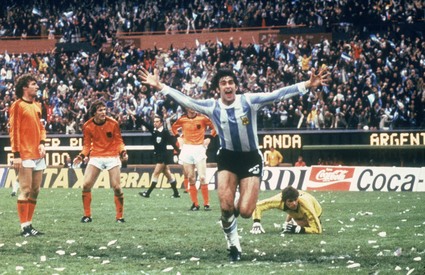
June 1978 Mario Kempes goes nuts after scoring during the 1978 World Cup Final between Argentina and Holland, held on June 25, 1978 at the River Plate Stadium, in Buenos Aires, Argentina. Argentina won 3-1 after extra-time.
The third final match against Germany was equally exciting. Both the teams played exceptionally well and the Argentinean team emerged as winners with a final score of 3-2.


The same enthusiasm was seen by the team during their 1990 match. The Argentina team played well, however due to a contraversial penalty they lost the match to Germany by 1-0.
Subscribe to:
Posts (Atom)